Hi timeline kin, imagine waking up in a village where yesterday your neighbor still had a few hidden potatoes buried under the floorboards, and today there’s nothing left but the sound of your own stomach and the wind through the empty grain bins. The children are too weak to cry anymore. The adults have stopped talking about spring planting because there’s no seed left to plant. The Soviet officials who came last month to collect “surplus” grain are long gone, and now no one—not even the dogs—has anything to eat. This wasn’t a natural famine. It wasn’t just bad weather or crop failure. It was a deliberate policy, enforced with guns and quotas and sealed borders, that killed millions in Ukraine in 1932–1933. The Holodomor (“death by hunger” in Ukrainian) is one of the most documented, most denied, and most emotionally explosive episodes of the 20th century. For decades, the Soviet Union insisted it never happened, or, if it did, it was just a tragic side effect of collectivization that affected every region equally. The survivors knew better. Their grandchildren still know better.
In 2026, when you ask Ukrainians why they fight so fiercely for their language, their land, their right to exist as a nation, many will quietly point back to those two winters when the state tried to erase them through starvation. This isn’t a neutral encyclopedia entry. It’s the longer, more human attempt to walk through what happened, how it was organized, why it targeted Ukraine so brutally, what the survivors carried with them, and why—almost a century later—the word “Holodomor” is still a live wire in global politics.
Stalin’s Collectivization Policies and the Causes of the Holodomor (1928–1930)
When Stalin ended the New Economic Policy in 1928 and launched forced collectivization, the goal was brutally simple: break the power of the peasantry, extract grain to pay for factories, and turn agriculture into a state-controlled machine that could never again threaten the regime with shortages or resistance. The countryside was the last place in Soviet Russia where private initiative still existed.
Peasants had small plots, animals, and tools. They sold surplus on the market. Stalin saw this as capitalism hiding in plain sight. So the state declared war on “kulaks” (supposedly rich peasants) and anyone who resisted joining collective farms (kolkhozes). Dekulakization was swift and savage.
Families were given hours to pack—one suitcase per person. Everything else—houses, cows, plows—was confiscated. “Kulaks” were deported to Siberia, Kazakhstan, the far north; many died in cattle cars or in special settlements where there was no food, no shelter, no medicine. The official target was 5–6% of peasant households. In reality, the label was applied randomly to anyone who owned more than one cow or had ever hired a laborer for a day. In Ukraine, the campaign was especially vicious.
Ukrainian peasants were already viewed with suspicion—national consciousness was strong, the Ukrainian language was widespread, and memories of the 1917–1921 independence struggle were still fresh. Stalin saw Ukrainian villages as a potential base for anti-Soviet nationalism. So the grain quotas for Ukraine were set impossibly high, even in districts that had already handed over everything.
1931–1932: Grain Quotas and Forced Requisitions During the Holodomor
By late 1931, the state was demanding grain that Ukraine simply did not have. Brigades of activists (often young urban communists who spoke little Ukrainian) went house to house with search warrants. They took seed grain, food reserves, even the last handful of beans hidden under the bed. If a family had nothing left, the brigade would fine them in kind—meaning they took the roof beams or the family icons if those were the only things of value left. Villages were blacklisted if they failed to meet quotas. Blacklisting meant:
- No trade allowed (no salt, no matches, no kerosene)
- No movement in or out (internal passports were introduced in December 1932 to lock peasants in place)
- Brigades could seize any food found.
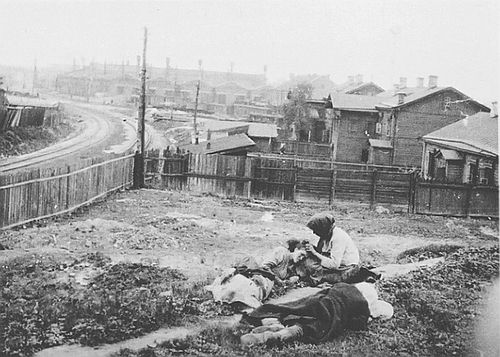
People began to die quietly at first—old people, then children, then adults. Bodies were collected at night so neighbors wouldn’t see how many were dying. In some villages, the death rate reached 30–40% in a few months. The borders were sealed. Trains carrying grain out of Ukraine passed trains carrying refugees trying to escape—and the refugees were turned back at gunpoint. Stalin explicitly ordered the OGPU (secret police) to prevent peasants from fleeing famine zones.
1933: Peak of the Holodomor Famine and Mass Death in Ukraine
The worst months were March–July 1933. Estimates vary because the state falsified records and destroyed evidence, but credible modern scholarship converges on 3.5–5 million excess deaths in Soviet Ukraine alone (higher if you include Kuban and other heavily Ukrainian regions in the North Caucasus and Volga). Some Ukrainian demographers argue the total is closer to 7 million when indirect deaths are included. What did it look like on the ground?
- Villages emptied. Houses stood with doors open, possessions untouched because no one had the strength to loot.
- Cannibalism appeared—not widespread, but real and documented in OGPU reports.
- Children were abandoned at orphanages or railway stations because their parents could no longer feed them.
- In Kyiv, people collapsed in the streets; police removed bodies at night.
One of the most haunting accounts comes from Gareth Jones, a Welsh journalist who walked through Ukrainian villages in spring 1933 and saw skeletal children and empty huts. His articles were dismissed by many Western journalists (notably Walter Duranty of the New York Times, who won a Pulitzer for denying the famine). Jones was murdered in Mongolia in 1935—many believe Stalin’s agents were involved.
Why Ukraine? The National Question
Stalin didn’t starve Ukraine by accident. He starved it on purpose. By 1932–1933, he was convinced Ukrainian nationalism was the biggest internal threat to the Soviet state. The Ukrainian Autocephalous Orthodox Church had been suppressed, Ukrainian intellectuals were being arrested, and the Ukrainian Communist Party had too many “national communists” who wanted more autonomy.
The famine was used to break the back of the Ukrainian peasantry—the social base of any potential independence movement. The Politburo decisions in November 1932 and January 1933 explicitly targeted Ukraine and the Kuban (a region with a large Ukrainian population).
Grain quotas were raised even as reports of mass starvation arrived. When Ukrainian party leaders begged for relief, Stalin accused them of “nationalist deviation” and purged them. It wasn’t genocide in the narrow legal sense (no evidence Stalin intended to destroy Ukrainians as a nation entirely), but it was targeted mass killing with national overtones. That is why Ukraine, Canada, the United States, Australia, and 20+ other countries recognize the Holodomor as genocide. Russia denies it to this day.
1933–1991: Soviet Cover-Up of the Holodomor and Decades of Silence
The Soviet state denied the famine existed. Foreign journalists were banned from Ukraine. Duranty’s articles called reports of starvation “exaggeration.” Diplomats who knew the truth kept quiet. Inside the USSR, mentioning the famine could get you arrested for “anti-Soviet agitation.”
Survivors were silenced by fear and shame. Many never told their children. The word “Holodomor” was not widely used until after Ukraine’s independence in 1991.
Holodomor Memory and Recognition in 2026: History, Politics, and National Identity
The Holodomor has become a central pillar of modern Ukraine’s national identity and historical memory.
Every year, the country marks a national day of remembrance (held in late November), honoring millions of victims through candlelighting ceremonies, educational programs, and official commemorations. Schools across Ukraine teach the Holodomor as a defining historical trauma, while major memorials—especially in Kyiv—serve as powerful reminders of the human cost of Soviet policies. Outside Ukraine, diaspora communities, particularly in Canada and the United States, have played a major role in pushing for international recognition and awareness.
Today, more than 20 countries officially recognize the Holodomor as genocide, linking it to the policies of Joseph Stalin and the broader system of forced collectivization and state repression.
However, the issue remains deeply contested. Russia rejects the genocide classification, arguing that the famine affected multiple regions of the Soviet Union and should not be viewed as a targeted national policy. This disagreement has turned the Holodomor into more than a historical debate—it is now part of ongoing geopolitical tensions, especially in the context of recent conflicts between Russia and Ukraine.
For many Ukrainians, the events of 1932–1933 are not distant history. They are seen as part of a longer struggle for survival, identity, and sovereignty. The memory of starvation, repression, and silence continues to shape how Ukrainians understand their past—and defend their future.
The Holodomor was not just a famine. It was a state-driven catastrophe that attempted to break a society by controlling its most basic resource: food. It came dangerously close to succeeding. It did not—because survivors carried the memory forward, and their descendants continue to keep that memory alive in 2026.
What part of this story stays with you?
The cruelty of the quotas? The silence that followed?
The way the memory is still fought over today?
Or the sheer human endurance that let people survive it?
Write whatever is on your mind below. I read every word.
Books that shaped how I understand the Holodomor:
- Red Famine: Stalin’s War on Ukraine by Anne Applebaum (the most comprehensive modern account)
- Harvest of Sorrow by Robert Conquest (the book that forced the West to confront the famine in the 1980s)
- The Years of Hunger: Soviet Agriculture 1931–1933 by R.W. Davies & Stephen G. Wheatcroft (detailed economic data, more conservative on death toll)
- Holodomor 1932–1933 by Stanislav Kulchytsky (Ukrainian perspective, strong on archival evidence)
- Voices from Chernobyl by Svetlana Alexievich (not directly about Holodomor, but shows how Soviet-era trauma echoes across generations)
Reliable sources I leaned on for key facts & numbers:
If you were moved by this account of the Holodomor, you may also like these related articles on the Soviet famines and Stalin’s brutal policies:




Comments