


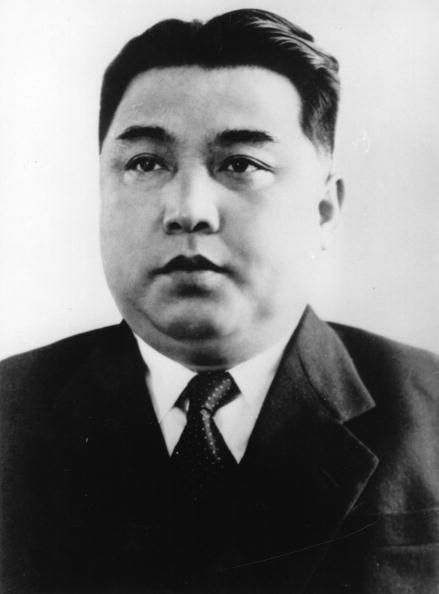
Hi timeline kin, A bitter winter wind howled through the snowy forests of eastern Manchuria one freezing night in February 1942 as a small guerrilla band huddled around a campfire. In a simple dugout, a young Korean fighter’s wife gave birth to a son. Wrapped in old blankets against the cold, the baby entered a world of exile, hunger, and constant danger. That child, born behind enemy lines while his parents fought the Japanese, would one day become the eternal ruler of North Korea. His name was Kim Il-sung.
This is the story of a guerrilla fighter who transformed himself into a living god, the founder of the world’s most isolated and hereditary dictatorship. From the snow-covered mountains of Manchuria to the marble halls of Pyongyang, Kim Il-sung built a cult of personality unlike any other in modern history — one that still shapes North Korea more than thirty years after his death.
Kim Il-sung Early Life and Guerrilla Resistance (1912–1945)
Born on 15 April 1912 in Mangyongdae, near Pyongyang, Kim Song-ju (his birth name) grew up in a family of modest means with strong anti-Japanese sentiments. When he was seven, his family fled Japanese-occupied Korea and settled in Manchuria. There, as a teenager, he joined underground resistance groups and became deeply involved in communist activities.
By the early 1930s, he had risen through the ranks of the Chinese-led anti-Japanese guerrilla forces in Manchuria. He adopted the nom de guerre Kim Il-sung (“Kim Become the Sun”). In 1937, he led a famous raid on the Japanese police post at Pochonbo — a small but symbolically powerful victory that made him a legend among Korean nationalists. Harassed relentlessly by Japanese forces, he eventually fled to the Soviet Union in 1940, where he received military training and served as a captain in the Soviet Red Army during the final years of World War II.
Return to Korea: Founding the DPRK and Consolidating Power (1945–1950)
When Japan surrendered in August 1945, the Soviets brought the now 33-year-old Kim Il-sung back to northern Korea. The country had been divided at the 38th parallel, with the Soviets occupying the north and the Americans the south. In Pyongyang, the Soviets installed Kim as the leading Korean communist figure. He quickly consolidated power, eliminating rivals and building a personality cult around himself.
On 9 September 1948, he formally established the Democratic People’s Republic of Korea (DPRK) and became its first premier. Within two years, with Stalin’s approval and Mao’s support, he launched a surprise invasion of South Korea on 25 June 1950, confident that he could unify the peninsula under communist rule in a matter of weeks.
The Korean War: Invasion, Defeat, and Survival (1950–1953)
The war did not go as planned. After early successes, UN forces under General MacArthur pushed the North Korean army almost to the Chinese border. Only massive Chinese intervention saved Kim’s regime. The fighting eventually stalemated near the original dividing line. An armistice was signed in July 1953, but no peace treaty ever followed.
The war devastated North Korea. Cities were reduced to rubble, and hundreds of thousands of civilians died. Yet Kim emerged from the conflict stronger than ever. He purged any remaining rivals, blamed “factionalists” for setbacks, and began rewriting history to portray himself as the sole savior of the Korean people.
Cult of Personality and Juche Ideology (1950s–1990s)
In the decades that followed, Kim Il-sung created one of the most extreme personality cults in history. He was declared the “Great Leader,” “Sun of the Nation,” and “Eternal President.” Every citizen was required to wear a badge with their portrait. His birthday became the biggest national holiday. Children were taught from infancy that he was infallible and god-like.
He developed the ideology of Juche (self-reliance), which in practice meant total isolation from the outside world and absolute loyalty to the Leader. Massive monuments, towering statues, and murals of Kim appeared everywhere. The entire calendar was adjusted so that Year 1 began with his birth. Even after his death, the constitution was changed to make him “Eternal President” of the DPRK.
Death and Legacy of Kim Il-sung (1994–Present)
By the early 1990s, Kim Il-sung was in failing health. North Korea faced severe economic collapse after the fall of the Soviet Union. Famine loomed. On 8 July 1994, at the age of 82, Kim Il-sung died of a heart attack at his residence in Pyongyang. His son, Kim Jong-il, took over in a smooth but secretive succession.

The Enduring Shadow of Kim Il-sung: North Korea’s Founder and Eternal Leader
More than thirty years after his death on 8 July 1994, Kim Il-sung remains the central figure of North Korean politics and society. His portraits continue to hang in every home, office, and public building, while colossal statues and monuments dominate Pyongyang and other cities. The North Korean regime enshrines him as the “Eternal President”, claiming he guides the nation even from beyond the grave.
Kim Il-sung transformed a devastated, post-World War II Korea into the world’s most isolated and tightly controlled hereditary dictatorship. Through the implementation of Juche ideology (self-reliance), a pervasive personality cult, and strict state control over society, he created a system that prioritizes absolute loyalty to the Kim family. Education, propaganda, and mass rituals all reinforce his image as an infallible leader, ensuring his influence persists decades after his death.
Whether remembered as a Korean independence fighter, a ruthless dictator, or a master of propaganda, Kim Il-sung fundamentally shaped North Korea’s political structure, social system, and foreign policy, leaving an enduring legacy that continues to define the Korean Peninsula today.
What lingers with you about this larger-than-life figure?
The young guerrilla fighter raiding Japanese outposts in the snowy mountains of Manchuria?
The Soviet-trained officer returning home in 1945 to build a new nation?
The moment he launched the invasion that started the Korean War?
Or the way he transformed himself into a living god whose cult still rules from the grave?
The young guerrilla fighter raiding Japanese outposts in the snowy mountains of Manchuria?
The Soviet-trained officer returning home in 1945 to build a new nation?
The moment he launched the invasion that started the Korean War?
Or the way he transformed himself into a living god whose cult still rules from the grave?
Write whatever is on your mind below. I read every word.
Books that shaped how I see Kim Il-sung:
Books that shaped how I see Kim Il-sung:
- Under the Loving Care of the Fatherly Leader by Bradley K. Martin
- The Great Leader and the Fighter Pilot by Blaine Harden
- Kim Il-sung: The North Korean Leader by Dae-Sook Suh
Reliable sources I leaned on for key facts:
- Britannica – Kim Il-sung
- Wikipedia – Kim Il-sung
- Wilson Center Digital Archive – Documents on Kim Il-sung and the Korean War
- BBC History – Kim Il-sung Profile
- National Museum of Korean Contemporary History – Early North Korea
- U.S. State Department – Office of the Historian – Korean War
Some leaders rule countries. Kim Il-sung built a religion with himself at its center — and that faith still endures.
Related Articles
- The Rise and Fall of Japan’s Greater East Asia Co-Prosperity Sphere
- Asia for Asians? The Dark Truth of Japanese Rule in World War II
- The Day the Guns Fell Silent: Japan’s Final WWII Surrender
- He Built a Nation… But at What Cost? The Story of Mao Zedong
- Douglas MacArthur: WWII Commander Who Promised “I Shall Return”
- Chiang Kai-shek’s Biggest Mistake That Changed Asia Forever


Comments