


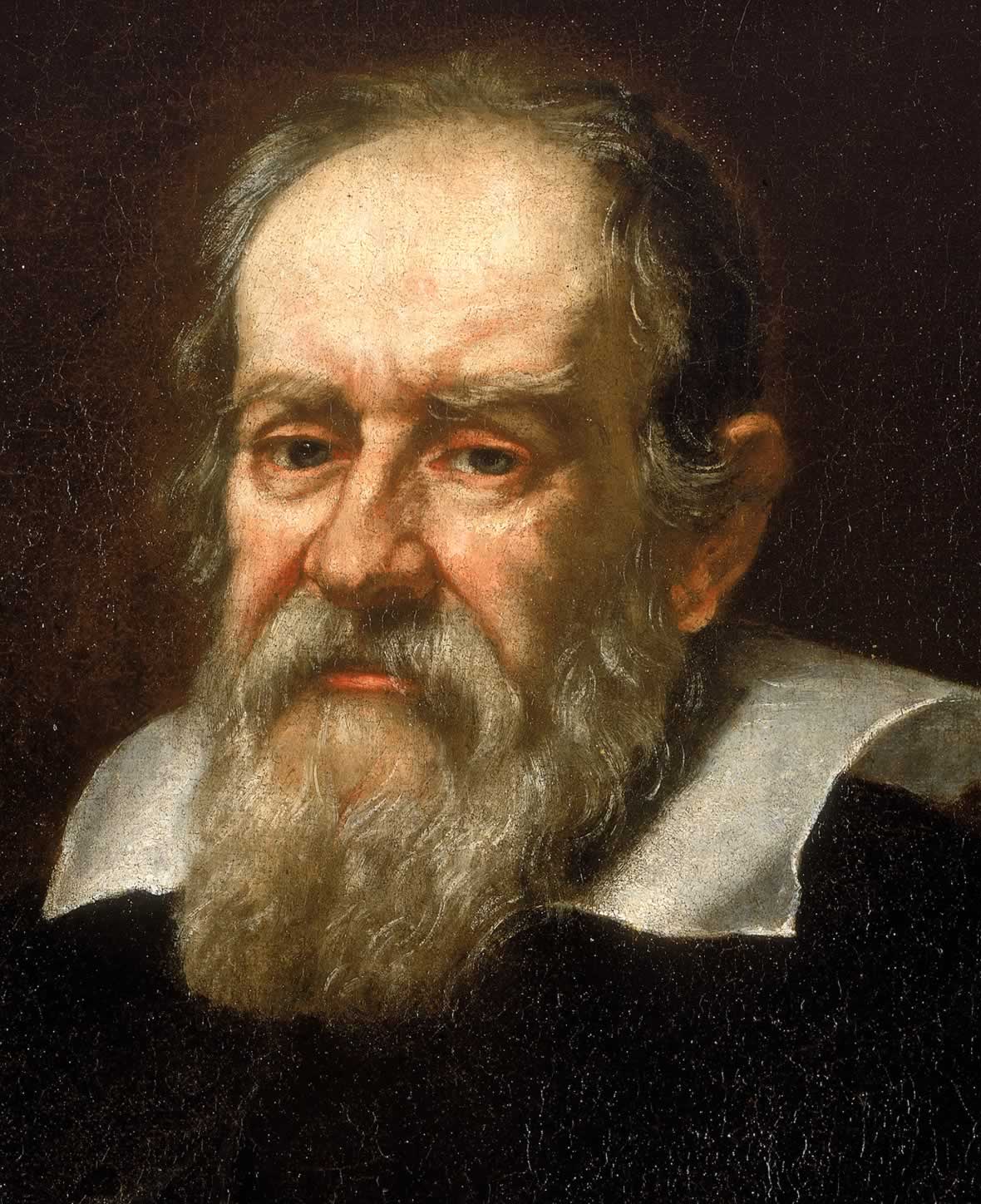
Hey timeline kin, This is the story of Galileo Galilei — the Italian astronomer who discovered Jupiter’s moons, provided powerful evidence for the heliocentric model, and faced the famous trial of Galileo in 1633 that shook the foundations of science and religion.
It begins on a warm spring evening in 1609 in the Italian city of Padua. A middle-aged professor with a sharp beard and restless eyes climbs the narrow stairs to the roof of his house, carrying a strange tube he has just finished building. The device is simple — two lenses fitted into a lead tube — but tonight it will change everything. He points it at the sky and peers through the eyepiece. What he sees makes his heart race: the Moon is not a smooth, perfect sphere as Aristotle taught, but a rugged world covered in mountains and craters. Jupiter has four tiny companions circling it like a miniature solar system. The Milky Way is not a misty cloud, but countless individual stars.
That man is Galileo Galilei. In the coming years, he will use this simple telescope to shatter centuries of accepted truth, challenge the authority of the Church, and lay the foundation for modern science. He will become both a hero and a heretic, a brilliant mind who looked up at the heavens and dared to say the Earth is not the center of the universe.
Galileo’s Early Life and the Leaning Tower Legend (1564–1609)
Galileo Galilei was born on February 15, 1564, in Pisa, the same year Shakespeare was born and Michelangelo died. His father was a musician and wool trader who wanted his son to become a doctor. Galileo studied medicine at the University of Pisa, but he was far more interested in mathematics and physics. He dropped out without a degree, yet his talent was so obvious that he was soon appointed professor of mathematics at the same university.
From the beginning, Galileo questioned authority. He publicly challenged Aristotle’s ideas about falling bodies. Legend says he dropped objects of different weights from the Leaning Tower of Pisa to prove they fall at the same speed — a story that may be partly myth, but perfectly captures his rebellious spirit.
Galileo’s Telescope Discoveries (1609–1616): Moon Craters, Jupiter’s Moons, and Proof Against Aristotle
In 1609, hearing rumors of a Dutch “spyglass,” Galileo built his own improved version and turned it toward the night sky. His observations were revolutionary. He discovered Jupiter’s four largest moons — now called the Galilean moons — proving that not everything revolves around the Earth. He saw the phases of Venus, which provided strong evidence for the heliocentric model proposed by Copernicus. He observed the Moon’s craters and mountains, showing that celestial bodies are not perfect spheres.
In 1610, he published Sidereus Nuncius (The Starry Messenger), announcing his discoveries. The book made him famous across Europe. He was appointed Chief Mathematician to the Grand Duke of Tuscany and moved to Florence. But his growing support for the Copernican idea — that the Earth moves around the Sun — brought him into direct conflict with the Catholic Church.
The Trial of Galileo in 1633: Science Meets Authority
In 1616, the Church had already warned Galileo not to teach or defend Copernicanism as fact. He promised to obey, but in 1632, he published Dialogue Concerning the Two Chief World Systems, a book written in Italian so ordinary people could read it. Although presented as a neutral discussion, it clearly favored the heliocentric model.
The Pope was furious. Galileo, then nearly seventy and in poor health, was summoned to Rome and tried by the Inquisition. On June 22, 1633, he was forced to kneel and recant his views. Legend says he whispered under his breath, “Eppur si muove” — “And yet it moves.” Whether true or not, the phrase has become a powerful symbol of scientific truth refusing to be silenced.
House Arrest and Final Years (1633–1642)
Galileo spent the rest of his life under house arrest at his villa in Arcetri, near Florence. Blind in his final years, he continued working, dictating his last book on the laws of motion to his students. He died on January 8, 1642, at the age of seventy-seven. The Church refused to allow him a proper burial in the family tomb. It was not until 1737 that his remains were moved to a more honorable resting place in the Basilica of Santa Croce in Florence.

Galileo’s Legacy: Why His Discoveries Changed Science Forever
Galileo Galilei did not invent the telescope, nor was he the first to propose that the Earth moves around the Sun. But he was the first to use systematic observation and mathematics to challenge ancient authority and show that the heavens are governed by the same physical laws that operate on Earth. He paid a heavy price for his honesty — humiliation, house arrest, and the suppression of his ideas — yet his work could not be buried forever.
Today, Galileo is considered one of the founders of modern science. His work proved that observation, experimentation, and mathematics — not authority — are the keys to understanding the universe. Every modern telescope and space observation traces its roots back to the moment Galileo first looked at the sky in 1609.
What part of Galileo’s life stays with you?
The young professor dropping objects from the Leaning Tower of Pisa?
The night he first pointed his telescope at the Moon and saw mountains?
The old man forced to kneel and recant before the Inquisition?
Or the quiet persistence of a scientist who kept working even after he was blind and under house arrest?
The young professor dropping objects from the Leaning Tower of Pisa?
The night he first pointed his telescope at the Moon and saw mountains?
The old man forced to kneel and recant before the Inquisition?
Or the quiet persistence of a scientist who kept working even after he was blind and under house arrest?
- ✅Who was Galileo Galilei?
Galileo Galilei was an Italian astronomer, physicist, and mathematician known as one of the founders of modern science. He improved the telescope, discovered Jupiter’s moons, and supported the heliocentric model of the universe. - ✅What did Galileo discover with his telescope?
Galileo discovered the four largest moons of Jupiter, the phases of Venus, mountains and craters on the Moon, and that the Milky Way is made of countless stars—proving the universe is more complex than previously believed. - ✅Why was Galileo put on trial in 1633?
The Galileo trial happened because Galileo supported the heliocentric theory that the Earth orbits the Sun, which conflicted with the teachings of the Catholic Church at the time. - ✅Did Galileo really say “And yet it moves”?
The phrase “Eppur si muove” (“And yet it moves”) is widely attributed to Galileo after his trial, but there is no solid historical evidence that he actually said it. It remains a powerful symbol of scientific truth. - ✅Why is Galileo important in modern science?
Galileo is important because he introduced the scientific method based on observation and experimentation. His work laid the foundation for modern physics and astronomy, influencing scientists like Isaac Newton.
Write whatever is on your mind below. I read every word.
Books that shaped how I see Galileo Galilei:
Books that shaped how I see Galileo Galilei:
- Galileo’s Daughter by Dava Sobel (beautiful, human portrait using his daughter’s letters)
- Galileo by J.L. Heilbron (detailed, scholarly biography)
- The Galileo Affair by Maurice A. Finocchiaro (documents from the trial)
- Galileo: A Very Short Introduction by Stillman Drake
- Sidereus Nuncius by Galileo Galilei (his own Starry Messenger)
Reliable sources I leaned on for key facts:
- The Galileo Project – Rice University
- Vatican Secret Archives – Galileo Trial Documents
- Britannica – Galileo Galilei
- Stanford Encyclopedia of Philosophy – Galileo
- Museo Galileo – Florence
Recommended Articles
- Edmond Halley’s Greatest Discovery: The First Predicted Comet in History – Astronomy after Galileo.
- The Secret Behind Newton’s Apple – The genius born in the year Galileo died.
- Gottfried Wilhelm Leibniz: The Genius Who Invented Calculus and Predicted Modern Computing – Another giant of the Scientific Revolution.
- From Sputnik to Starlink: The Complete History of Satellites and the New Space Age – From Galileo’s telescope to space exploration.
- What If Computers Never Existed? – How Galileo’s science helped create the modern world.


Comments