


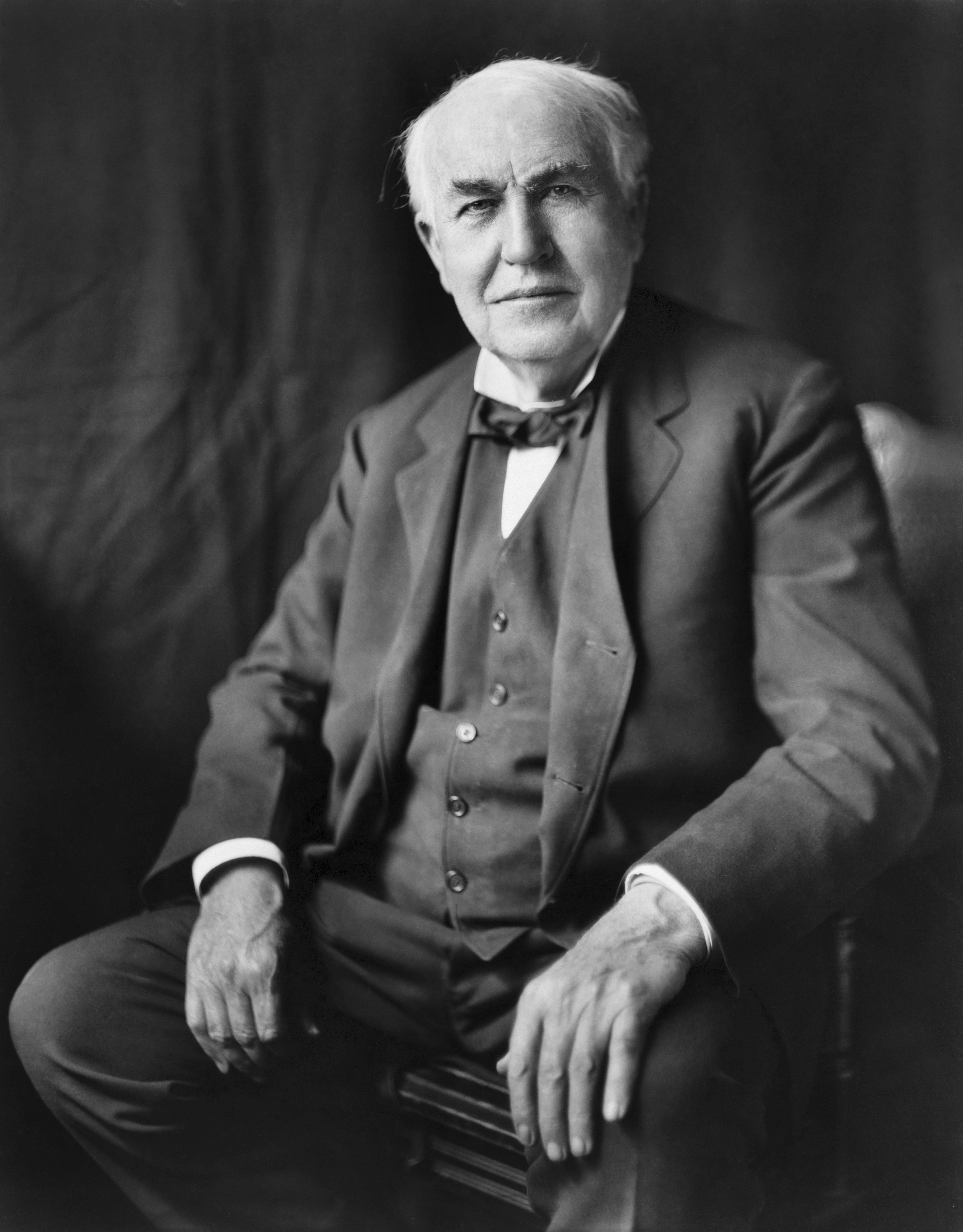
Hey timeline kin, This is the story of Thomas Edison’s inventions — including the light bulb, phonograph, and motion picture camera — and how they transformed the modern world.
It’s a freezing winter night in 1879 in the small town of Menlo Park, New Jersey. A determined man with wild hair and ink-stained fingers stands in a cluttered wooden laboratory surrounded by glass bulbs, copper wires, and the faint smell of burning bamboo. He has been working for days without sleep. His team watches in exhausted silence as he carefully slips a thin carbonized filament into a glass globe, pumps out the air, and seals it. He connects the wires to a battery. A soft orange glow appears, then brightens into a steady, warm light. The room fills with quiet cheers. Thomas Edison has just created a practical incandescent light bulb that can burn for hours. Edison’s light bulb invention became the foundation of modern electric lighting systems used worldwide today, making him widely known as the man who perfected the light bulb.
A Curious Boy Who Never Stopped Asking Questions (1847–1863)
Thomas Alva Edison was born on February 11, 1847, in Milan, Ohio. He was the youngest of seven children. His father was a shingle maker and speculator; his mother was a former schoolteacher who homeschooled him after teachers complained he was “addled” and distracted. Edison later said his mother was the best teacher he ever had.
From an early age, he was insatiably curious. He set up a small chemistry lab in his parents’ basement and sold newspapers and candy on trains to fund his experiments. At twelve, he lost most of his hearing after a conductor boxed his ears. The deafness never slowed him down — he claimed it helped him concentrate.
The Young Inventor & the Birth of Menlo Park (1863–1876)
Edison began his career as a telegraph operator. He improved telegraph equipment and sold his first invention, an electric vote recorder, at age twenty-one. It failed commercially because politicians didn’t want their votes recorded so quickly.
In 1876, he moved to Menlo Park, New Jersey, and built the world’s first industrial research laboratory — a place where invention became a systematic process rather than a lone genius’s flash of insight. He called it his “invention factory.” He gathered a team of brilliant assistants and promised results on demand.
The Light Bulb & the War of the Currents (1879–1890s)
Edison’s most famous achievement came in 1879 when he developed a practical incandescent light bulb using a carbonized bamboo filament that could burn for over 1,200 hours. He didn’t invent the light bulb — many others had tried before — but he made it commercially viable and built the entire electrical system (generators, wiring, meters) to support it.
This led to the famous “War of the Currents” against Nikola Tesla and George Westinghouse. Edison championed direct current (DC). Tesla and Westinghouse pushed alternating current (AC). The War of the Currents became one of the most famous rivalries in the history of electricity and innovation. Edison waged a ruthless public campaign, even electrocuting animals to demonstrate AC’s supposed danger. In the end, AC won because it could transmit power over long distances far more efficiently. Edison lost the battle but still became enormously wealthy.
Motion Pictures, the Phonograph & Later Years (1880s–1931)
Edison also invented the phonograph (1877) — the first machine to record and reproduce sound — and pioneered motion pictures with the Kinetoscope. He opened the first movie studio, the Black Maria, in 1893.
In his later years, he worked on electric cars, rubber from goldenrod plants, and a talking doll. He became a national hero and a symbol of American ingenuity. When he died on October 18, 1931, at the age of 84, lights across America were dimmed for one minute in his honor.
What Did Thomas Edison Invent?
- Practical incandescent light bulb (modern electric lighting system)
- Phonograph (first sound recording and playback device)
- Motion picture camera (early film technology)
- Industrial research laboratory (foundation of modern R&D)
- Electrical power distribution systems

Thomas Edison’s Legacy: Why His Inventions Still Shape the Modern World
Today, Thomas Edison’s inventions continue to shape modern life — from electric lighting systems and power distribution to sound recording and the film industry. His development of the practical light bulb and integrated electrical system helped bring electricity into homes and cities, transforming how people live and work.
The modern world doesn’t just use electricity — it runs on the innovative systems Thomas Edison pioneered, influencing everything from global infrastructure to today’s technology-driven industries.
What part of Thomas Edison’s life stays with you?
The tireless inventor who worked days without sleep in Menlo Park?
The ruthless competitor who battled Tesla in the War of the Currents?
The showman who built the first movie studio and recorded sound for the first time?
Or the old man who kept experimenting until the very end, still believing there was always one more invention waiting to be discovered?
The tireless inventor who worked days without sleep in Menlo Park?
The ruthless competitor who battled Tesla in the War of the Currents?
The showman who built the first movie studio and recorded sound for the first time?
Or the old man who kept experimenting until the very end, still believing there was always one more invention waiting to be discovered?
Write whatever is on your mind below. I read every word.
Books that shaped how I see Thomas Edison:
Books that shaped how I see Thomas Edison:
- Edison: A Biography by Matthew Josephson (classic, detailed)
- The Wizard of Menlo Park by Randall Stross (modern, critical look)
- Empires of Light by Jill Jonnes (focus on the War of the Currents)
- Edison’s Eve by Gaby Wood (on his talking doll and other odd inventions)
- The Papers of Thomas A. Edison (multi-volume scholarly edition)
Reliable sources I leaned on for key facts:
- Edison National Historic Site – National Park Service
- The Thomas Edison Papers – Rutgers University
- Britannica – Thomas Edison
- Library of Congress – Edison Collection
- IEEE – Edison Archives
Recommended Articles
- How Electricity Conquered the Night and Changed Human Civilization – The power source Edison helped bring to the masses.
- The History of Telephone and Mobile Communication – Communication technology from the same revolutionary era.
- How Cars and Motorcycles Reshaped the Modern World – Another invention that transformed daily life.
- From Sputnik to Starlink: The Complete History of Satellites and the New Space Age – From light bulbs to satellites.
- What If Computers Never Existed? – The long road from Edison to the digital world.


Comments