


Yo timeline kin, stand in the shell-cratered mud of the Douaumont ridge on February 21, 1916, just before first light. The ground trembles before you even hear the sound—a low, rolling growl that builds until the entire horizon erupts in overlapping flashes.
Over a thousand German guns, some of them the biggest ever fired on the Western Front, open simultaneously. The noise is no longer sound; it is pressure, a physical weight that presses on your chest and makes your teeth ache. Trees vaporize. Stone bunkers fold inward like wet cardboard. Men who were alive a minute ago simply disappear. In the German trenches opposite, a tall, hawk-faced general in his mid-fifties stands on a sandbag step, field-glasses steady, watching the bombardment he personally ordered. His name is Erich von Falkenhayn. He has chosen this place, this moment, to bleed the French army white—not to capture ground, but to kill as many French soldiers as possible until France can fight no more. He believes he can win the war here, on this one scarred hillside, by turning battle into a machine that runs on human lives.He was wrong.
The Battle of Verdun would last ten months, cost nearly three-quarters of a million casualties, and end with both armies still staring at each other across the same chewed-up earth they started on. It became the longest single battle of the First World War, the symbol of industrialized attrition, and—for France—the sacred wound they still call “the furnace.”
The Battle of Verdun would last ten months, cost nearly three-quarters of a million casualties, and end with both armies still staring at each other across the same chewed-up earth they started on. It became the longest single battle of the First World War, the symbol of industrialized attrition, and—for France—the sacred wound they still call “the furnace.”
Why Verdun? Falkenhayn’s Cold Calculation (Late 1915–February 1916)
By the end of 1915, the Western Front had ossified into a network of trenches. Falkenhayn, Chief of the German General Staff since 1914, believed breakthroughs were no longer possible. He decided to target a place France could not afford to lose—not for strategic value, but for emotional value. Verdun was a fortress-city with ancient symbolic weight: it had never fallen to a foreign enemy, guarded the road to Paris, and was tied to French national identity. Falkenhayn’s plan was brutally simple: attack Verdun so ferociously that France would be forced to defend it at any cost, then feed division after division into the meat-grinder until the French army broke from sheer exhaustion.
He chose February 21, 1916, because the ground would still be frozen (easier for artillery and movement) and because he hoped to strike before the British could launch their own offensive on the Somme. He massed over 1,200 guns (including the 420 mm “Big Bertha” howitzers) and five armies—roughly 1.25 million men in the sector by the end. The French had about 270,000 men in the Verdun sector, under General Philippe Pétain.
The Opening Barrage & the First Weeks (February 21 – March 1916)
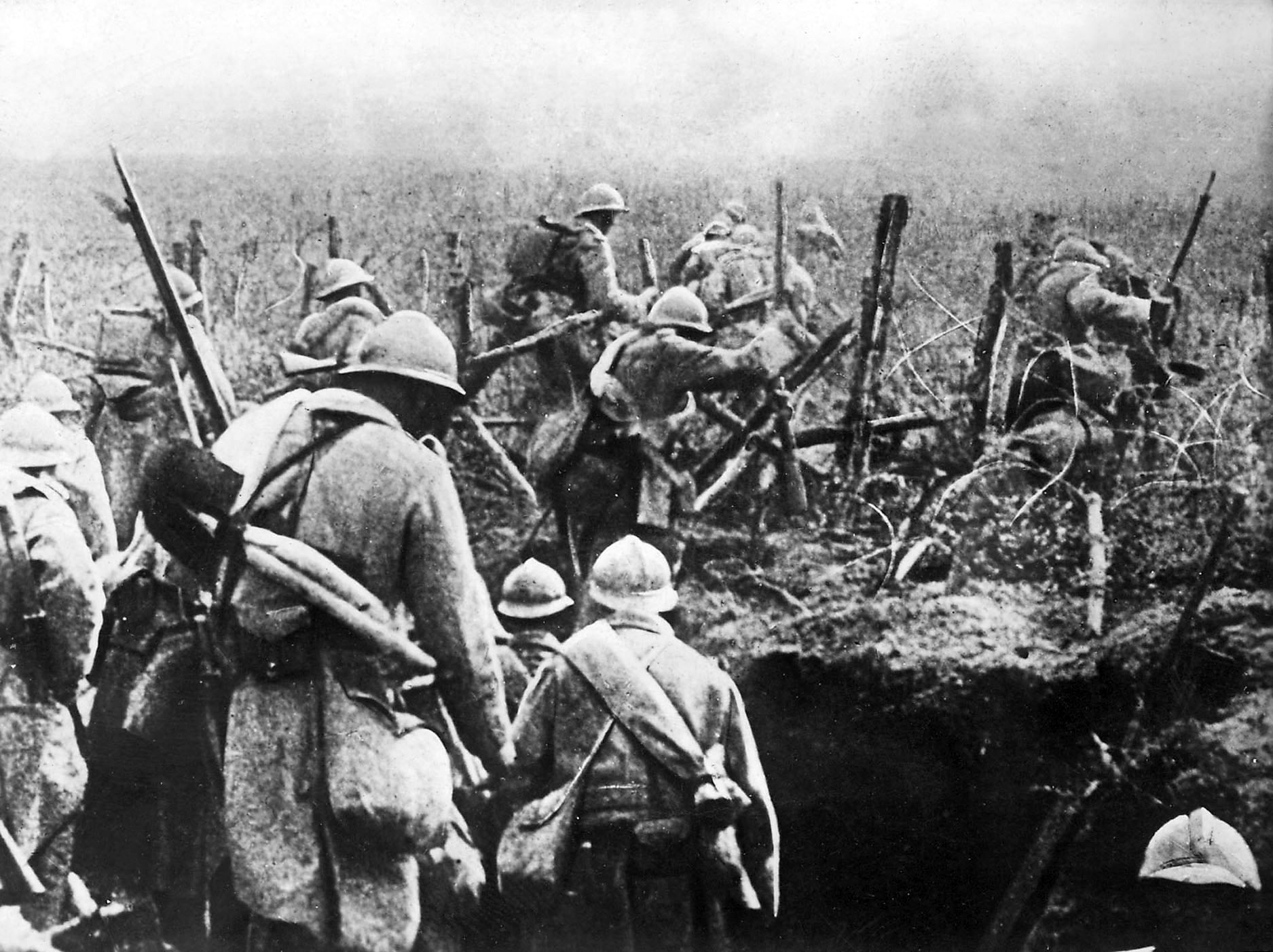
At 7:15 a.m. on February 21, the German guns opened fire. For nine hours, they fired over 1 million shells—more artillery than had ever been concentrated in one place. Entire forests disappeared. The French front-line trenches were obliterated. On February 25, the Germans took Fort Douaumont—France’s strongest fortress—almost by accident when a small patrol wandered in through an unguarded entrance. Pétain took command the same day and issued his famous order: “Ils ne passeront pas” (“They shall not pass”).
Pétain stopped the panic. He rotated divisions so no unit stayed under fire for too long (the “noria” system) and organized the Voie Sacrée. This single dirt road kept Verdun supplied (3,000 trucks a day, one every fourteen seconds), and turned Verdun into a national symbol. French soldiers fought knowing the whole country was watching.
The Germans took Fort Vaux in June after months of underground fighting and flamethrowers. But they could not break the line. Falkenhayn had miscalculated: the French refused to bleed themselves dry defending every inch. Pétain gave ground when necessary and counter-attacked when possible. The battle became a mutual slaughter.
The Meat-Grinder & the Final Months (April–December 1916)
Both sides fed men into Verdun like coal into a furnace. The French suffered ~377,000 casualties (163,000 dead); the Germans ~337,000 (143,000 dead). The deadliest day was May 1: over 10,000 men fell on both sides. Gas, flamethrowers, underground mines, hand-to-hand fighting in shell-holes—the entire vocabulary of industrialized horror was invented or perfected here.
In June, Falkenhayn was forced to divert troops to the Somme and the Brusilov Offensive in the east. The French launched their own counter-offensive in October–December 1916, recapturing Douaumont and Vaux. By December, the front line was almost exactly where it had been in February. The battle ended not with victory, but with mutual exhaustion.
Falkenhayn’s Fall & the Legacy
Falkenhayn was sacked on August 29, 1916. Hindenburg and Ludendorff took over. He never commanded again in the field. His “bleeding-white” strategy had failed: the French army did not collapse; it endured. Verdun became the symbol of French resistance—“They shall not pass”—and the place where both armies learned the true cost of attrition.
In 2026, when visitors walk the Ossuary at Douaumont (containing the bones of ~130,000 unidentified dead) or stand inside the restored Fort Douaumont, they feel the weight of Falkenhayn’s calculation: a battle fought not to gain ground, but to kill. It cost both nations a generation and convinced millions that modern war had become a form of mutual suicide.
What part of Verdun lingers with you? The nine-hour bombardment that erased forests? Pétain’s calm rotation system that kept the army from breaking? Falkenhayn’s cold decision to turn a battle into a slaughterhouse? Or the simple, terrible fact that after ten months and three-quarters of a million casualties, the front line had barely moved? Drop whatever is on your mind below. I read every word.
Books that shaped how I see Verdun:
- Verdun 1916 by Alistair Horne (the classic narrative—still the best read)
- The Price of Glory: Verdun 1916 by Alistair Horne (same author, updated edition)
- Verdun by Paul Jankowski (recent, balanced, uses French & German archives)
- The Fortress by Alexander Watson (focus on Fort Douaumont & Vaux)
- German Strategy in the Great War by Holger Afflerbach (Falkenhayn’s thinking & the “bleeding white” plan)
Reliable sources I leaned on for key facts:
- Service Historique de la Défense – Verdun Archives — French military records & orders
- Bundesarchiv – Falkenhayn & Verdun Papers — German planning documents & casualty lists
- Verdun Memorial Official Site — battlefield maps, statistics, Ossuary records
- Britannica – Battle of Verdun — timeline & evaluation
- The Great War Primary Documents Archive — Pétain’s orders, Falkenhayn’s memos
If you found this harrowing account of the Battle of Verdun insightful, you may also like these related articles on the brutal Western Front and the leaders who shaped the conflict:
- The Somme Battle That Consumed a Million Lives — The equally devastating British offensive launched in 1916 while Verdun was still raging.
- Douglas Haig: The Commander Who Refused to Stop Fighting — Britain’s controversial field marshal whose decisions defined the Battle of the Somme.
- Ferdinand Foch and the Battle That Saved Paris — The French general who later became Supreme Allied Commander and helped turn the tide after Verdun.
- Georges Clemenceau: The Tiger Who Refused to Let France Fall — The fiery French Prime Minister who demanded unrelenting resistance during the darkest days of Verdun.
- France’s Relentless President: The Story of Raymond Poincaré — The French president who oversaw the defense of Verdun and pushed for total victory.
- Wilhelm II and the Road to World War I: Ambition, Power, and Miscalculation — The German Kaiser, whose aggressive policies helped create the conditions for the slaughter at Verdun.


Comments