


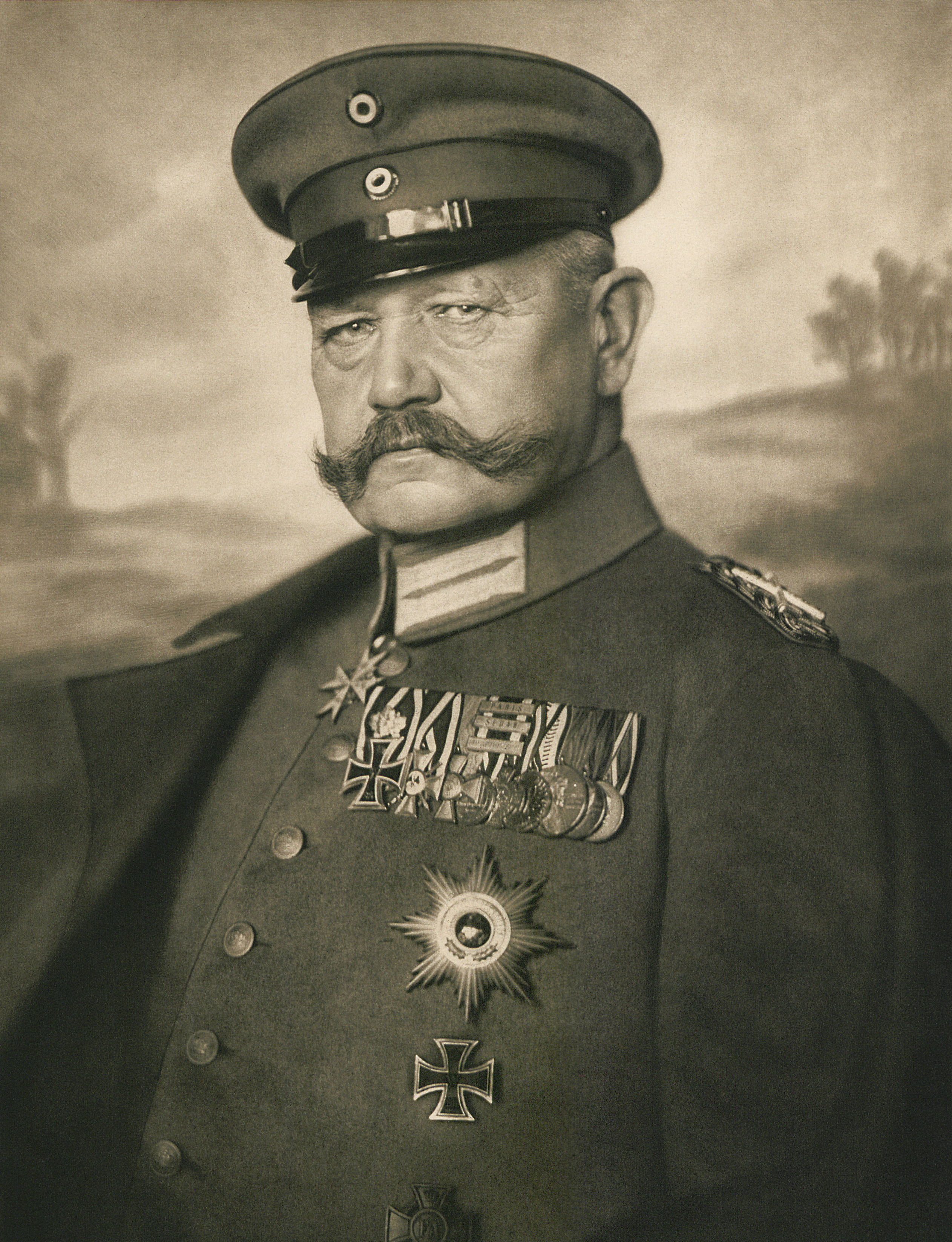
Hei, timeline Kin, In the winter of 1914, at a small East Prussian railway station, snow fell in thick, silent flakes as a train arrived. A tall, heavily built man in his late sixties stepped onto the platform, wearing a long greatcoat adorned only with the Iron Cross. His weathered face and steady eyes reflected experience and resolve. Without luggage or fanfare, he acknowledged the waiting delegation with a single nod before departing for headquarters in Posen.The officers recognized Paul Ludwig Hans Anton von Beneckendorff und von Hindenburg, a retired general recalled to service as the German army struggled on two fronts and sought a leader to inspire confidence. Over the next four years, Hindenburg would become Germany’s most powerful military figure, achieve national acclaim, share command with Erich Ludendorff in a near-military dictatorship, and, after the war, oversee the end of the Weimar Republic by appointing Adolf Hitler chancellor.
That snowy arrival in August 1914 marked a turning point in Hindenburg’s life. Before then, he was a mostly overlooked Junker general who had retired in 1911 after a respectable but unremarkable career. Afterward, he became the symbol of German military strength, known as the “Victor of Tannenberg,” the leader who held the Eastern Front together, and eventually the elderly president whose signature in January 1933 gave control of Germany to the Nazis.
The Making of a Prussian Officer – Early Life & Career (1847–1911)
Paul von Hindenburg was born on October 2, 1847, in Posen (now Poznań, Poland), then part of the Kingdom of Prussia. His family was part of the old Junker nobility, landed gentry with deep roots in the military caste that had built Prussia. His father was a career officer; his mother came from a similar background. The family name carried weight: “von Beneckendorff und von Hindenburg” signaled longstanding lineage and service to the crown.
He entered the Prussian cadet corps at eleven. In 1866, at the age of nineteen, he fought in the Austro-Prussian War and was wounded at Königgrätz. In 1870–71, he served in the Franco-Prussian War, took part in the encirclement of Paris, and was present at the proclamation of the German Empire in Versailles. He rose steadily through the ranks—staff college, battalion command, division command—always competent, always loyal, never brilliant. He retired in 1911 at age 64 as a colonel-general, comfortable and respected, but largely unknown outside military circles. He spent his days hunting, writing letters, and serving as the honorary president of veterans’ associations.
The Recall of Hindenburg and the Battle of Tannenberg (1914)
When World War I broke out in August 1914, the German General Staff faced disaster in the east. Two Russian armies were advancing into East Prussia. The Eighth Army was retreating. Moltke the Younger (chief of the General Staff) needed a steady hand to prevent panic. Someone suggested Hindenburg—old, calm, Prussian, a name that would calm the public and the army. On August 22, 1914, Hindenburg was recalled and appointed commander of the Eighth Army. His chief of staff was Erich Ludendorff, a brilliant, ruthless staff officer who had just captured the fortress of Liège.
The partnership was prompt and resolute. At the Battle of Tannenberg (August 26–30, 1914), Hindenburg and Ludendorff encircled and destroyed Samsonov’s Second Russian Army, over 90,000 prisoners, and Samsonov’s suicide. A week later, they crushed Rennenkampf’s First Army at the Masurian Lakes. The double victory made Hindenburg a national hero overnight. Churches rang bells. Newspapers called him “the savior of East Prussia.” Postcards showed him standing on a hill, field glasses in hand, while Russian armies crumbled below.
The victories were real, but they were mostly Ludendorff’s operational work. Hindenburg provided the calm authority, the prestige, the willingness to sign off on daring risks. The public did not care about the division of labor; they wanted a father figure. Hindenburg became that figure.
From Eastern Hero to Co-Dictator – The Third Supreme Command (1916–1918)
After Verdun and the Somme (1916), the German army was bleeding out. Falkenhayn was sacked. On August 29, 1916, Hindenburg was appointed Chief of the General Staff, with Ludendorff as his First Quartermaster General. They became the de facto rulers of Germany—controlling strategy, production, manpower, even propaganda and food rationing.
They introduced:
- The Hindenburg Programme — total industrial mobilization.
- The Auxiliary Service Law — forced labor for men 17–60.
- Unrestricted submarine warfare (January 1917) — the decision that brought America into the war.
Wilhelm II signed their orders but no longer shaped them. Hindenburg treated the Kaiser with polite deference and then did what he and Ludendorff wanted. By 1918, the war was lost. On September 29, 1918, Ludendorff told Hindenburg and the Kaiser that defeat was inevitable. Hindenburg agreed and urged an immediate armistice. Wilhelm was stunned—he had believed the army’s propaganda about final victory. The military now drove the peace process.
Abdication & Exile – The End of the Monarchy (November 1918)
On November 9, 1918, Chancellor Max von Baden announced Wilhelm’s abdication without his consent. Berlin was in revolutionary hands. The army refused to fight for the Kaiser. Wilhelm fled to Spa, then crossed into the Netherlands on November 10. He lived at Huis Doorn until his death on June 4, 1941, at the age of 82. He never returned to Germany.

The Man Who Bridged Empire and Dictatorship
Paul von Hindenburg was not a brilliant strategist, but a symbol of stability—an experienced Prussian officer shaped by discipline, hierarchy, and loyalty to the state. During World War I, victories on the Eastern Front made him a national hero, though he exercised real operational power largely alongside Erich Ludendorff. Together, they helped prolong a war Germany could no longer win.
By 1918, Hindenburg accepted the inevitability of defeat and supported the armistice that ended the German Empire. In 1925, he returned as president of the Weimar Republic, widely seen as a stabilizing figure during the political and economic crisis. However, his reliance on emergency decrees and conservative elites weakened democratic institutions at a critical moment.
His most consequential decision came on January 30, 1933, when he appointed Adolf Hitler as chancellor. Intended as a controlled political compromise, the appointment instead enabled the rapid collapse of democracy and the rise of the Nazi regime.
Today, Hindenburg remains a contested figure. Some view him as an aging statesman overwhelmed by events, while others see him as a key enabler of authoritarian rule. From a modern perspective, he stands as a transitional figure between imperial Germany and Nazi dictatorship—whose decisions helped shape one of the most consequential political shifts of the 20th century.
What part of Hindenburg’s story stays with you? The old general summoned from retirement to save East Prussia? The quiet way he and Ludendorff pushed the Kaiser aside? The moment he told Wilhelm the war was lost? Or the final signature in January 1933 that handed Germany to Hitler? Drop whatever is on your mind below. I read every word.
Books that shaped how I see Hindenburg:
- Hindenburg: Rule of the Old Guard by John Wheeler-Bennett (classic biography, still essential)
- Hindenburg: The Wooden Titan by John Wheeler-Bennett (same author, updated edition)
- The Iron Hindenburg by Anna von der Goltz (focuses on his public image and myth-making)
- Hindenburg and the Weimar Republic by Andreas Dorpalen (political role in 1925–1934)
- The German Army in the First World War by David T. Zabecki (context on Hindenburg & Ludendorff’s command)
Reliable sources I leaned on for key facts:
- Bundesarchiv – Hindenburg Papers — digitized letters, orders, photos
- Deutsches Historisches Museum – Hindenburg — German museum entry
- German Historical Institute London – Weimar & Hindenburg — scholarly articles
- The Hindenburg Programme – Primary Documents — German military records & memos
- Britannica – Paul von Hindenburg — timeline & evaluation
If you found this examination of Hindenburg’s role in the rise and fall of the Weimar Republic insightful, you may also like these related articles on the turbulent transition from empire to dictatorship in Germany:
- The Fall of the German Empire: Wilhelm II, Revolution, and the Birth of Weimar (1918) — How Germany’s defeat in World War I led to revolution, the abdication of the Kaiser, and the fragile birth of the Weimar Republic.
- Wilhelm II: The Emperor Who Watched His Empire Collapse — The story of the last German Kaiser whose downfall created the unstable political environment Hindenburg later inherited.
- The Beer Hall Putsch and the Unexpected Rise of Adolf Hitler — How the chaos of the early Weimar years gave Hitler his first opportunity to seize power.
- From Peace to Chaos: Europe After World War I — The economic despair, political instability, and resentment that defined the Weimar era.
- Inside the Hall of Mirrors: When Germany Was Humbled at Versailles — The harsh Treaty of Versailles that burdened the Weimar Republic from its very beginning.
- Wilhelm II and the Road to World War I: Ambition, Power, and Miscalculation — The pre-war decisions that ultimately contributed to the conditions in which Hindenburg rose to power.


Comments