
Hey, timeline kin, stand at the rail of a pitching destroyer in the North Sea, December 1914. Spray lashes your face, the deck tilts under your boots, and a stocky man in a long naval coat grips the stanchion with both hands, refusing to go below even though the wind is cutting through every layer he owns. He is forty years old, already balding, already famous, already hated in equal measure.
He has just ordered the Royal Navy to bombard the Belgian coast to support the army ashore, and he has come along to watch the shells fall. His name is Winston Churchill. First Lord of the Admiralty. The man most people in Britain blame for the Antwerp fiasco two months earlier and the one they will blame far more bitterly when Gallipoli unfolds next year.Right now, he looks like a boy playing at war—chin up, eyes bright, talking loudly over the wind about how this single operation will change everything. In truth, he is terrified the war will end before he has done something historic. He does not yet know that the next four years will nearly destroy him, that he will resign in disgrace, serve in the trenches as a major, claw his way back into cabinet, and then—twenty-five years later—become the one voice that refuses to let Britain surrender when almost everyone else is ready to bargain.
This is not the story-book Churchill of 1940, all cigar smoke and V-signs and speeches that still make spines stiffen. This is the younger, hungrier, more reckless man who spent the first half of his life collecting failures almost as fast as he collected headlines, and who somehow turned every disaster into the next rung of a ladder nobody else could see.
A Child of Empire & Neglect (1874–1895)
Winston Leonard Spencer Churchill was born on November 30, 1874, at Blenheim Palace—too early, during a ball his mother was still attending. His father was Lord Randolph Churchill, a brilliant, unstable Tory politician who flamed out early. His mother was Jennie Jerome, an American heiress, beautiful and restless. Neither parent had much time for the boy. Randolph was usually in Parliament or at the Turf Club; Jennie was usually at parties or with lovers. Winston grew up in boarding schools he hated, writing letters home that were rarely answered.
He was small, red-haired, lisping, accident-prone, and fearless in a way that looked like stupidity. He fell off ponies, fell out of trees, nearly drowned in a Swiss lake, and nearly died of pneumonia. He was at the bottom of his class at Harrow, hopeless at Latin and mathematics, but he could recite Macaulay’s Lays of Ancient Rome by heart and write English prose that already had a distinctive rhythm. In 1893, he scraped into Sandhurst on his third attempt. He graduated eighth out of 150 in cavalry tactics and horsemanship—his real talents.
War Correspondent & Early Fame (1895–1900)
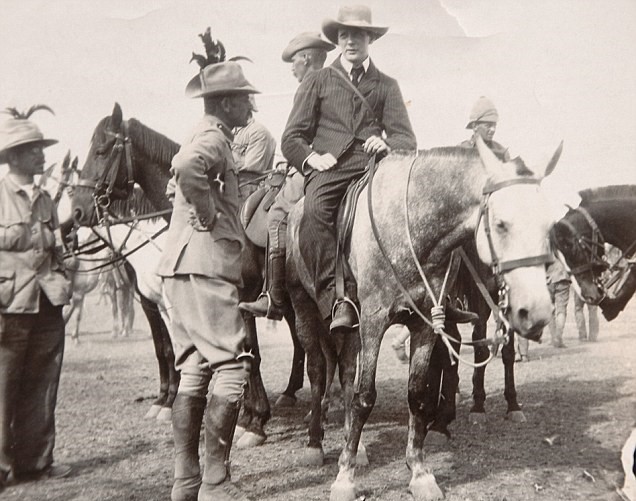
Churchill wanted glory and money. He used family connections to get himself posted to Cuba (1895) as an observer with the Spanish army, then to the North-West Frontier of India (1897) with the Malakand Field Force, then to Sudan (1898) with Kitchener’s army at Omdurman, and finally to South Africa (1899) as a correspondent for the Morning Post during the Boer War.
He was captured by the Boers, escaped from a prisoner-of-war camp in Pretoria, hid in a coal mine, walked 300 miles to Portuguese East Africa, and returned to Britain a national hero at twenty-five. His books—My Early Life, The Story of the Malakand Field Force, The River War, London to Ladysmith via Pretoria—made him rich and famous. He was already a celebrity before he was thirty.
Crossing the Floor & Radical Reformer (1900–1914)
In 1900, he entered Parliament as a Conservative MP for Oldham. Four years later, he crossed the floor to the Liberals over Joseph Chamberlain’s tariff reform plan—free trade was sacred to him. The Conservatives never forgave him; for the next decade, he was called “the traitor” whenever he spoke.
As a Liberal, he rose fast:
- Under-Secretary for the Colonies (1905–1908)
- President of the Board of Trade (1908–1910) — created labour exchanges, limited working hours in sweated trades
- Home Secretary (1910–1911) — sent troops against striking Welsh miners (Tonypandy), broke a siege in Sidney Street, and introduced the Shops Act.
- First Lord of the Admiralty (1911–1915) — modernized the navy, switched from coal to oil, created the Royal Naval Air Service, pushed for the tank.
He was energetic, inventive, and widely disliked. Conservatives saw him as a turncoat; Liberals distrusted his aristocratic roots. When war broke out in 1914, he was blamed for everything that went wrong at sea.
Gallipoli & the Wilderness Years (1915–1922)
The Gallipoli Campaign (1915–1916), strongly backed by Churchill, aimed to knock the Ottoman Empire out of the war but ended in heavy losses and strategic failure, damaging his reputation for years. It was his idea—force the straits, knock Turkey out of the war, relieve Russia, open a supply route to the Black Sea. It failed catastrophically: 250,000 Allied casualties, no strategic gain. Churchill resigned in disgrace in May 1915. He went to the Western Front as a major in the Grenadier Guards, lived in trenches, led night patrols, and waited for the political tide to turn.
He returned to government as Minister of Munitions (1917–1919), then as Secretary for War and Air (1919–1921), and finally as Colonial Secretary (1921–1922). He helped create the Irish Free State, bombed Bolsheviks in Russia, backed Zionism in Palestine, and used poison gas against rebellious Iraqi tribesmen (a decision that still haunts his reputation).
The Liberals collapsed in 1922. Churchill lost his seat and spent two years as a back-bencher without a party. In 1924, he rejoined the Conservatives (“the political journey is over”), won Epping, and became Chancellor of the Exchequer under Baldwin (1924–1929). He put Britain back on the gold standard at the pre-war parity—a decision almost everyone now agrees was a catastrophe. Unemployment soared. The General Strike of 1926 hardened class lines. Churchill broke it with ruthless efficiency.
Churchill’s Political Wilderness and Rise to Power in 1940
After the Conservatives lost in 1929, Churchill was out of office for eleven years—the longest stretch of his career. He wrote history (Marlborough, The World Crisis), made money on the stock market and in journalism, and spent most of the 1930s warning about Hitler when almost no one wanted to listen. He opposed Indian self-government, supported Edward VIII during the abdication crisis (a serious misjudgment), and became politically toxic. In May 1940, when Chamberlain fell, many expected Lord Halifax to take over. Instead, George VI sent for Churchill. On May 10, 1940, he became prime minister at the age of 65.
The rest is the story everyone knows: the speeches, the defiance, the coalition that won the war. But that is another chapter.
The Man Who Refused to Surrender
Winston Churchill remains one of the most influential—and debated—leaders of the 20th century. Known for his resilience during World War II, Churchill combined bold leadership with controversial decisions, including the Gallipoli Campaign and the return to the gold standard in the 1920s.
Despite political setbacks and criticism, his defining moment came in 1940, when his speeches and refusal to negotiate with Adolf Hitler helped sustain British morale during its darkest hour. His leadership transformed him from a divisive politician into a symbol of national resistance.
Today, Churchill’s legacy is complex: praised for his wartime leadership and rhetoric, yet scrutinized for his imperial views and policy failures. In modern historical analysis, he stands not as a flawless hero but as a decisive leader whose resolve shaped the outcome of the war and the future of Europe.
What part of Churchill’s long, stormy life stays with you? The naval boy who never expected a crown? The radical chancellor who taxed dukes to pay for pensions? The disgraced war minister who went to the trenches? Or the old man who finally got the top job when the world was on fire? Drop whatever is on your mind below. I read every word.
Books that shaped how I see Churchill:
- Churchill: Walking with Destiny by Andrew Roberts (the modern standard—full access to new diaries & papers)
- Churchill: A Life by Martin Gilbert (official biography, exhaustive detail)
- Churchill: The Prophetic Statesman by James H. Holmes (focus on his foresight & misjudgments)
- The Last Lion by William Manchester (vivid narrative trilogy—unfinished by Manchester, completed by Paul Reid)
- Hero of the Empire by Candice Millard (young Churchill in South Africa—wonderful storytelling)
Reliable sources I leaned on for key facts:
If you enjoyed this, look at Churchill’s dramatic career—from reckless early mistakes to his finest hour as wartime leader—you may also like these related articles on World War II leadership and the Battle for Britain:




Comments