


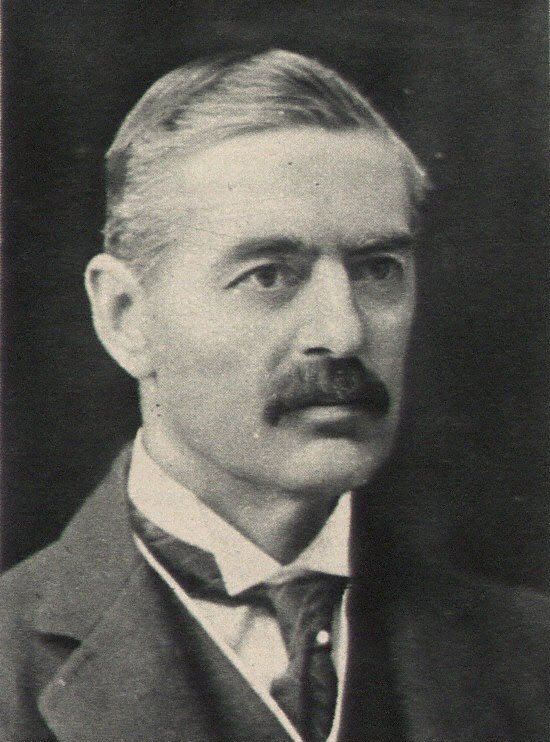
Hey timeline kin, picture a quiet Sunday morning in September 1938 inside a modest terraced house on Edgbaston’s Harborne Road, Birmingham. The wireless is switched on low, curtains half-drawn against the drizzle. A tall, spare man in his late sixties sits at the breakfast table in a plain dressing-gown, pipe unlit between his teeth, staring at the folded copy of The Times without really reading it.
His wife, Annie, is pouring tea; she knows he will barely touch it. In a few hours, he will board an aeroplane for the first time in his life, fly to Munich, and sit down with Adolf Hitler in the hope of bringing back “peace for our time.” The headlines already call the trip “dramatic”; his own backbenchers are muttering that he is either a saint or a fool. He knows the odds are poor, yet he still believes—against each instinct of his cautious, businesslike nature—that one more conversation, one more concession, might stop the slide toward another war.His name is Neville Chamberlain. In the next twelve months, he will become the most loved and then the most reviled British prime minister of the 20th century, the architect of appeasement who tried to buy peace with territory and promises, only to watch those promises turn to ash when Hitler marched into Prague in March 1939. The policy he championed would define an entire era—and brand him, unfairly but indelibly, as the man who fed a crocodile hoping it would eat him last.
The Latecomer to Politics – A Businessman’s Son in Public Life (1869–1920s)
Arthur Neville Chamberlain was born on March 18, 1869, in Edgbaston, Birmingham—the younger son of Joseph Chamberlain, the great Liberal-turned-Unionist imperialist who dominated late-Victorian politics. Neville was never meant for the spotlight; his half-brother Austen was the political heir apparent. Neville was sent to Rugby School (where he was miserable), then to Mason College (now Birmingham University) to study metallurgy, then to the Bahamas to manage a failed sisal plantation (1889–1897). The tropical experiment cost the family money and seven years of Neville's time, but it showed him bookkeeping, patience, and how to manage men.
Back in Birmingham, he built a successful business career in metal-screw manufacturing, property, and local charities. In 1911, he married Annie de Vere Cole, a bright, artistic woman who became his closest confidante. He entered local politics as a Birmingham councillor in 1911, lord mayor 1915–1917, and director-general of National Service 1917–1918 (a frustrating wartime post). He entered Parliament only in 1918 at forty-nine—late by any standard—winning Birmingham Ladywood as a Conservative. He never lost his seat.
The Quiet Rise – Health, Housing & the Treasury (1920s–1931)
Chamberlain was a master of detail, not oratory. He disliked the limelight but loved administration. As Minister of Health (1923, 1924–1929, 1931), he passed the landmark Housing Act 1924 (subsidies for council houses), reformed the poor law, built 1.5 million homes, and created the modern local government system. He was the most effective domestic minister of the inter-war years—dry, methodical, respected even by Labour opponents.
In 1931, he became Chancellor of the Exchequer under Ramsay MacDonald’s National Government. He balanced the budget, kept Britain on the gold standard until it was forced off, and steered the country through the worst of the Depression with orthodox finance. He was dull on the platform but formidable in committee. By 1935, he was heir apparent to Stanley Baldwin.
Appeasement & the Munich Years (1935–1939)
When Baldwin retired in May 1937, Chamberlain became prime minister at the age of 68. He inherited a rearming Germany, an isolationist United States, a pacifist public, a divided France, and an overstretched empire. He believed another war would destroy European civilisation and that Britain was too weak—militarily and financially—to fight one in 1938. His policy—appeasement—was not cowardice; it was calculated delay. Rearm, negotiate, buy time, and hope Hitler could be satisfied with limited gains.
- 1936: Rhineland remilitarization — Britain did nothing.
- 1938: Anschluss with Austria — again, no action.
- September 1938: Sudeten crisis — Chamberlain flew to Germany three times, met Hitler at Berchtesgaden, Bad Godesberg, and then Munich. At Munich (September 29–30), he agreed to cede the Sudetenland to Germany without Czech participation. He returned, waving the famous piece of paper: “Peace for our time.”
The policy is bought for eleven months. Hitler seized the rest of Czechoslovakia in March 1939. Chamberlain finally abandoned appeasement, guaranteed Poland, and—when Germany invaded on September 1, 1939—took Britain into war.
War & Resignation (1939–1940)
The “Phoney War” months were cruel to him. He was blamed for unpreparedness, for trusting Hitler, for failing to rearm faster. The Norway campaign disaster (April–May 1940) finished him. On May 10, 1940—the day Germany invaded the Low Countries—the House of Commons turned on him in the Norway Debate. His majority fell to 81. That evening, he resigned. Churchill took over. Chamberlain stayed in the war cabinet until cancer forced him out in September. He died on November 9, 1940, aged seventy-one. Churchill’s tribute in the Commons was generous: “He had always the bearing of a statesman… In war, he was a lion.”
A Reputation Forged at Munich
Neville Chamberlain is remembered almost entirely for Munich and the word “appeasement”—now a synonym for weakness. Yet he was a serious, hardworking administrator who actually believed another war would ruin Europe and that diplomacy could still work with Hitler. He was wrong, catastrophically so, but not dishonourable. He rearmed Britain faster than any pre-war premier (RAF expansion, radar, conscription in 1939), and when war came, he led the country into it with a clear conscience.
In 2026, when people reread his Munich speech or see the grainy newsreel of him waving that piece of paper, they often have a mix of pity and anger: pity for the man who thought he had saved peace, anger that he misjudged Hitler so badly. He was not a fool. He was a decent man who made the wrong bet at the most inopportune moment.
What part of Chamberlain’s story stays with you? The Birmingham businessman who became prime minister late in life? The chancellor who balanced budgets during the Depression? The prime minister who flew to Hitler three times in one month, hoping to stop a war? Or the tragic figure who returned, waving peace, only to have to declare war anyway? Drop whatever is on your mind below. I read every word.
Books that influenced how I see Neville Chamberlain:
- Neville Chamberlain by David Dilks (two-volume official biography—detailed, sympathetic but frank)
- Neville Chamberlain: A Biography by Robert Self (modern, balanced reassessment)
- Appeasing Hitler by Tim Bouverie (vivid narrative of the appeasement years)
- The Chamberlain Legacy by Arthur Balfour (focus on domestic achievements)
- Britain and the Origins of the New Europe 1914–1918 by Kenneth J. Calder (context on Chamberlain’s early views)
Reliable sources I leaned on for key facts:
- The National Archives UK – Chamberlain Papers — digitised letters, diaries, cabinet minutes
- Parliament.uk – Chamberlain’s Speeches — Munich debate, Norway debate, war declaration
- Britannica – Neville Chamberlain — timeline & evaluation
- Birmingham City Archives – Chamberlain Collection — family & early life documents
- Imperial War Museums – Appeasement Era — context on Munich & public mood
Recommended Articles
- Winston Churchill: The Reckless Politician Who Became Britain’s Wartime Hero – The leader who replaced Chamberlain and opposed appeasement.
- The Molotov–Ribbentrop Pact: One of History’s Most Cynical Deals – The cynical agreement that sealed Poland’s fate.
- The Lightning War That Erased Poland from the Map – The invasion that proved appeasement had failed.
- The Battle of Britain: When Hitler Failed to Conquer the Skies – Britain’s stand after Munich.
- Dunkirk and the Fall of France: The 6 Weeks That Shocked the World – The collapse that exposed the weakness of the pre-war policy.


Comments