


Hey timeline kin, it’s a humid July morning in 1934 at the Kasumigaura naval air station north of Tokyo. The sun is already fierce, turning the tarmac into a shimmering black mirror. A group of young pilots in crisp white uniforms stands at attention beside a row of sleek Mitsubishi B1M torpedo bombers. At the head of the line is a compact, serious officer in his early fifties, cap low over his eyes, hands clasped behind his back. He wears no medals today—just the plain uniform of a rear admiral. He walks slowly down the row, stopping at each plane to run a finger along the leading edge of a wing, checking for dust. Then he turns to the pilots and speaks in a quiet, measured voice that still carries to the back rank: “Gentlemen, the next war will be decided in the air. Not on battleship decks. Not in the minds of admirals who dream of Tsushima again. In the air. And we are not ready.”
The officer is Isoroku Yamamoto. In the next seven years, he will rise to command the Imperial Japanese Navy’s Combined Fleet, plan the attack on Pearl Harbor, lead the carrier force that stunned the world, and die in a blazing aircraft over Bougainville—shot down by American P-38s in an ambush he never saw coming. He will become Japan’s most famous admiral, a reluctant warrior who tried to warn his country against the very war he helped start, and whose name still evokes both admiration and tragedy more than eighty years later.
Isoroku Yamamoto’s Early Life: A Samurai’s Son in a Modern Navy (1884–1919)
Isoroku Yamamoto was born Takano Isoroku on April 4, 1884, in Nagaoka, Niigata Prefecture. His father was a former samurai who had fought on the losing side in the Boshin War (1868–1869), the civil conflict that ended the shogunate and brought the Meiji Restoration. The family lost everything—land, status, pride. Young Isoroku grew up in poverty, but his father instilled in him the old samurai code: duty, loyalty, courage. At sixteen, he entered the Imperial Japanese Naval Academy (Etajima) and graduated eighth in his class in 1904.
He served on the cruiser Nisshin during the Russo-Japanese War (1904–1905), was wounded at the Battle of Tsushima (shrapnel in both legs and his left hand—two fingers permanently lost), and earned a reputation for coolness under fire. After the war, he studied at Harvard (1919–1921), learned English fluently, traveled America, and developed a deep respect for its industrial power and democratic spirit. He came home convinced Japan could never win a long war against the United States.
Why Isoroku Yamamoto Believed Aircraft Carriers Would Win the War (1920s–1930s)
In the 1920s, Yamamoto was posted to the naval attaché’s office in Washington, then to the London Naval Conference (1929–1930) as a delegate. He saw Britain and America dominate naval negotiations and realized Japan’s economy could not sustain a battleship race. He turned to aviation.
Back in Japan, he learned to fly (despite missing fingers), commanded the First Carrier Division (1934–1935), and became the navy’s leading advocate for carrier-based air power. He clashed with traditional “big-gun” admirals who still dreamed of another Tsushima. He warned repeatedly: “Any war with America would be a war of attrition we cannot win. We must avoid it at all costs.”Yet he also believed that if war came, Japan’s only hope was a decisive first strike to cripple the U.S. Pacific Fleet and buy time to seize the southern resource areas (Dutch East Indies oil, Malayan rubber, Indonesian tin). In 1939, he was appointed Commander-in-Chief of the Combined Fleet—the youngest ever. He accepted the post reluctantly, knowing war was coming.
Pearl Harbor & the Opening Moves (1941–1942)
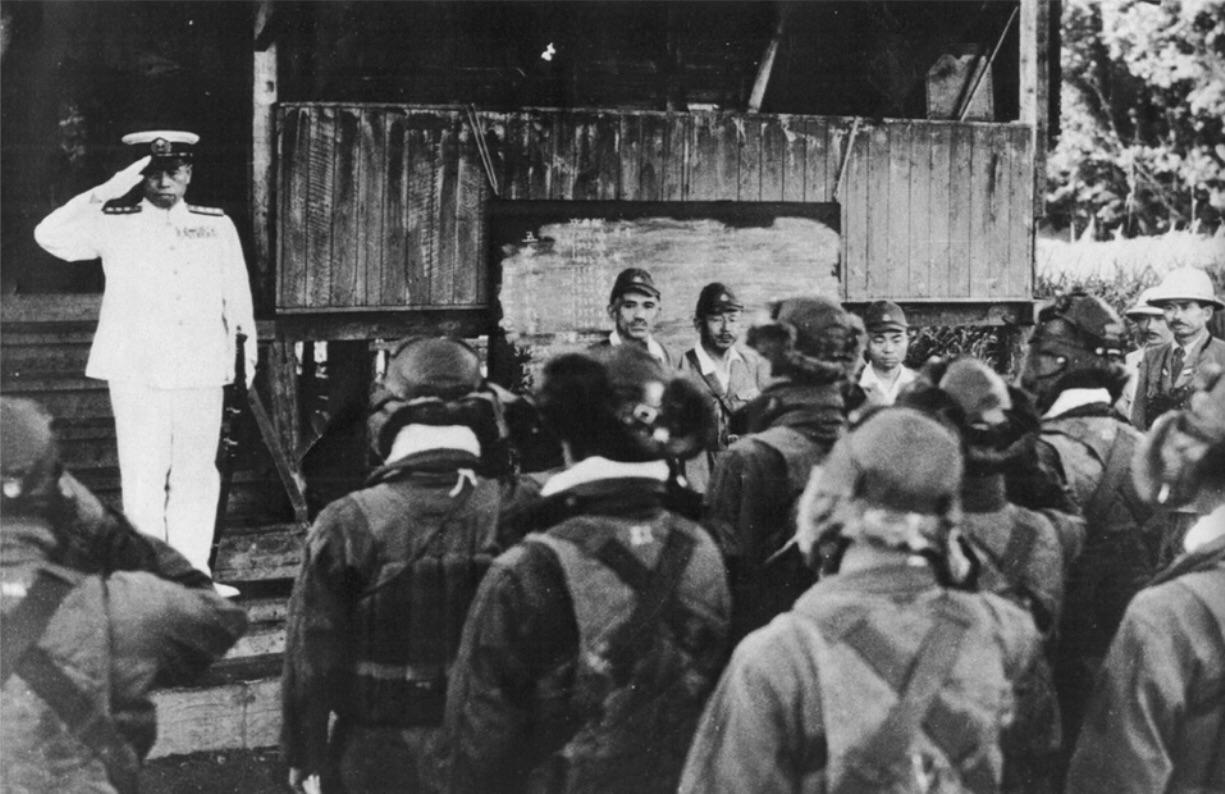
Yamamoto planned Pearl Harbor himself. He insisted on six carriers, surprise, and a shallow-water torpedo modification. He opposed war with America but believed that if it must happen, Japan had to strike first and hard. The attack (December 7, 1941) succeeded tactically—eight battleships sunk or damaged—but missed the carriers and fuel depots. Yamamoto reportedly said: “I fear all we have done is to awaken a sleeping giant and fill him with a terrible resolve.”He led the fleet in the Indian Ocean raid (April 1942), then at Midway (June 1942). Midway was his greatest defeat. Four carriers lost, air groups shattered. The Imperial Navy never recovered offensive power.
The Long Retreat & Death (1942–1943)
After Midway, Yamamoto shifted to a defensive strategy—Guadalcanal, the Solomons, the Gilberts. He flew inspection tours to boost morale. On April 18, 1943, American code-breakers (Magic) intercepted his itinerary. P-38 Lightnings from Guadalcanal ambushed his Mitsubishi G4M bomber over Bougainville. Yamamoto’s plane crashed in the jungle. He was found in the wreckage, still gripping his sword, dead from a bullet to the head.
His death was kept secret for weeks. When announced, Japan mourned deeply—he was the last admiral with real strategic vision.
Lessons From the Admiral Who Planned Pearl Harbor
Yamamoto was no fanatic. He opposed war with America from the start, saying famously: “I can run wild for six months… after that, I have no expectation of success.” He was right. He planned the attack on Pearl Harbor because he believed it was the only way to win quickly. When it failed to knock America out, he knew the war was lost. He fought on anyway—loyalty to the emperor, duty to the navy, no real way to stop the machine once it started.
In Japan today, he is remembered as a tragic figure: the admiral who foresaw disaster, tried to avert it, then led the fleet to its doom. In America, he is respected as a worthy enemy—honorable, brilliant, never accused of war crimes.
What part of Yamamoto’s story stays with you?
The young naval cadet who lost two fingers at Tsushima?
The Harvard-educated attaché who warned Japan against America?
The architect of Pearl Harbor who feared he had awakened a giant?
Or the admiral who died in a jungle crash, still clutching his sword, knowing the war was already lost?
The young naval cadet who lost two fingers at Tsushima?
The Harvard-educated attaché who warned Japan against America?
The architect of Pearl Harbor who feared he had awakened a giant?
Or the admiral who died in a jungle crash, still clutching his sword, knowing the war was already lost?
Write whatever is on your mind below. I read every word.
Books that shaped how I see Yamamoto:
- Yamamoto: The Man Who Planned Pearl Harbor by Hiroyuki Agawa (Japanese perspective, intimate)
- The Reluctant Admiral by Hiroyuki Agawa (same author, English edition)
- Yamamoto: His Life and Times by Edwin P. Hoyt (balanced biography)
- Shattered Sword by Jonathan Parshall & Anthony Tully (Midway from the Japanese side, excellent on Yamamoto’s decisions)
- Combined Fleet Decoded by John Prados (signals intelligence & Yamamoto’s role)
Reliable sources I leaned on for key facts:
- National Diet Library – Yamamoto Isoroku Collection (Japanese archives, letters, reports)
- Imperial Japanese Navy Page – Combined Fleet (detailed ship & commander records)
- U.S. Naval History & Heritage Command – Yamamoto (American intelligence & after-action reports)
- Britannica – Isoroku Yamamoto
- Pearl Harbor Aviation Museum – Fuchida & Yamamoto
Recommended Articles
- How Japan’s Attack on Pearl Harbor Changed the World – The global consequences of Yamamoto’s bold plan.
- Mitsuo Fuchida: The Japanese Pilot Behind Pearl Harbor – The pilot who executed Yamamoto’s vision.
- Franklin D. Roosevelt: The President Who Changed America Forever – The U.S. leader who answered Yamamoto’s strike.
- The Pacific War: The Brutal Conflict That Reshaped Asia Forever – The wider war Yamamoto helped start but feared losing.
- Winston Churchill: The Reckless Politician Who Became Britain’s Wartime Hero – The British prime minister who welcomed America’s entry after Pearl Harbor.


Comments