


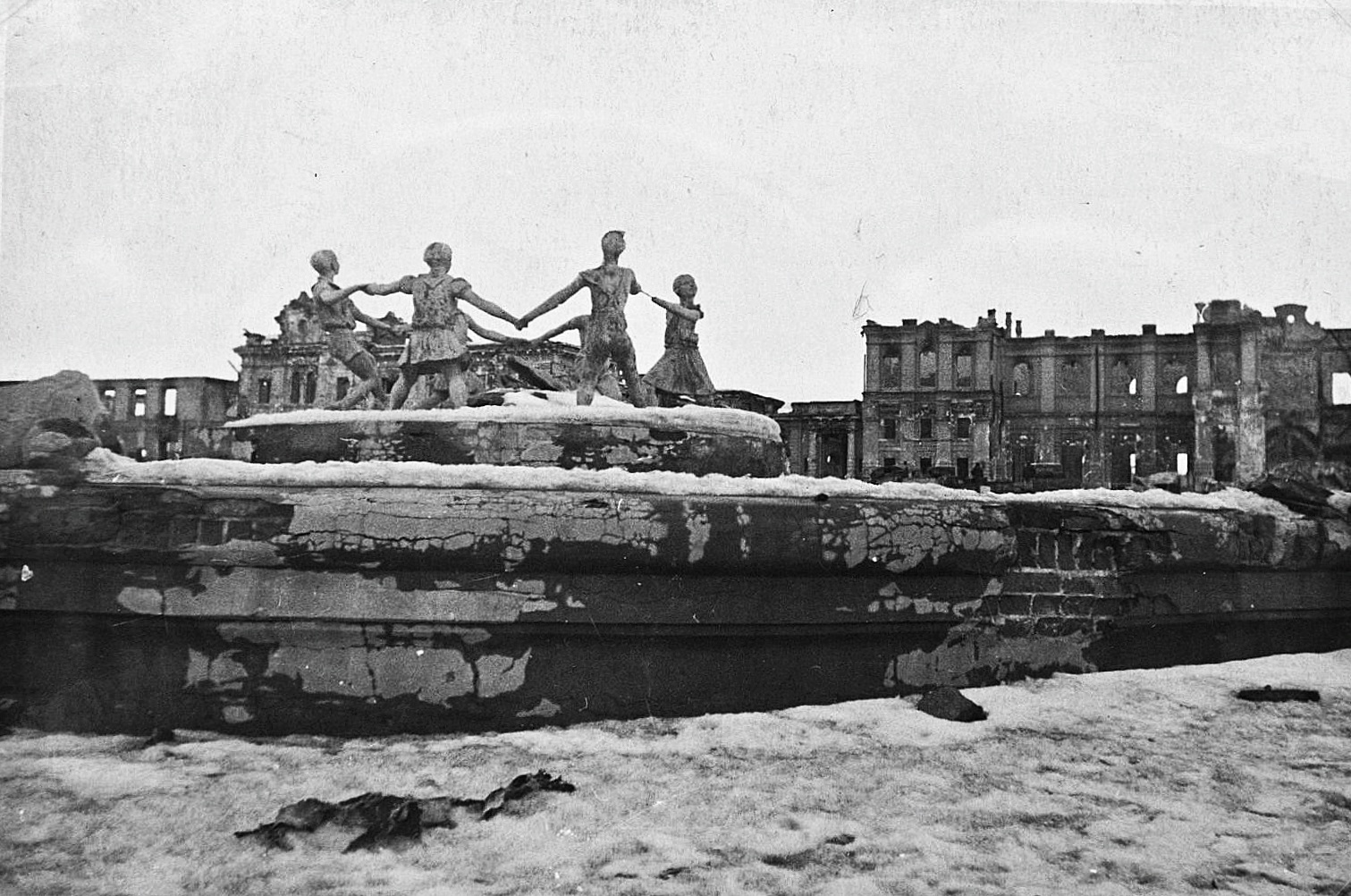
Hey timeline kin, it’s late November 1942, and you’re crouched amid the ruins of a half-collapsed apartment block on the western edge of Stalingrad. Snow is falling in heavy, silent flakes that settle on the broken concrete and the frozen bodies still lying where they fell. The temperature is –25 °C. Your breath freezes instantly into a white cloud that stings your lips.
Somewhere nearby, a German MG-34 is firing short, disciplined bursts, answered by the slower, heavier boom of a Soviet Maxim. The sound never really stops; it just ebbs and flows like surf. You can smell cordite, burnt oil, and the sweet-rot stench of unburied dead. A rat the size of a cat scuttles past your boot. You don’t even flinch anymore.Across the street—in what used to be a bakery—a squad of Red Army soldiers is sharing a single potato, passing it hand to hand. One of them, a boy who looks barely sixteen, is murmuring the same sentence over and over: “They’re not coming. Paulus is surrounded. We hold the line.” He says it as if a prayer. He’s right. The Sixth Army is trapped. The trap is about to snap shut.
This is Stalingrad—not a battle in the classic sense, but a slow, grinding, man-made hell that lasted 199 days and cost more lives than any single engagement of the entire war. It was the moment the Wehrmacht’s aura of invincibility cracked, the high-water mark of Nazi expansion, and the psychological turning point that convinced millions—on both sides—that Germany could lose.
The Road to the Volga – Summer 1942
After the failure of Barbarossa in 1941, Hitler shifted strategy for 1942. He no longer aimed to take Moscow. Instead, Directive 41 ordered Army Group South to seize the Caucasus oil fields (Maikop, Grozny, Baku) and the city of Stalingrad on the Volga. The city had symbolic value—it bore Stalin’s name—as well as strategic value: it controlled river traffic and rail links to the south.
Case Blue (Fall Blau) began in June 1942. The Wehrmacht advanced with frightening speed: Rostov fell, the Don River was crossed, and the Caucasus oil fields were within reach. By late August, the Sixth Army under Friedrich Paulus reached the outskirts of Stalingrad. Hitler ordered the city to be taken at all costs. Stalin ordered it held at all costs. The stage was set.
Urban Warfare in Stalingrad – September to November 1942
Stalingrad was not fought in open fields. It was fought street by street, floor by floor, room by room. The Germans reached the Volga by mid-September. The city became a maze of rubble—every ruined building a fortress, every sewer a tunnel, every pile of bricks a machine-gun nest.
German advantages:
- Superior small-unit tactics.
- Better artillery support early on.
- Luftwaffe air supremacy (until November).
Soviet advantages:
- Endless reinforcements (Stalin fed divisions into the grinder).
- Ruthless discipline (“Not one step back” – Order 227).
- Familiarity with winter.
- Growing numbers of T-34 tanks and Katyusha rockets.
The fighting was medieval in its savagery: hand-to-hand combat with bayonets, shovels, bricks; snipers hunting each other across rooftops; soldiers fighting for control of a single staircase for days. Pavlov’s House—a four-story apartment block—held out for 58 days against repeated assaults. The Grain Elevator was defended by a handful of Soviet marines for five days until ammunition ran out.
By mid-November, the Germans controlled 90% of the city, but their flanks were dangerously exposed—held by Romanian, Italian, and Hungarian troops who were under-equipped and demoralized.

Operation Uranus – The Soviet Counter-Strike (November 19, 1942)
On November 19, the Red Army launched Operation Uranus. Two massive pincers—southwest and northwest of Stalingrad—smashed through the weak Axis satellite armies. Within four days, the two Soviet fronts met at Kalach on the Don, encircling the entire Sixth Army and parts of the Fourth Panzer Army—about 250,000–300,000 men trapped in a pocket 40 miles wide.
Paulus asked permission to break out. Hitler refused: “Fortress Stalingrad will be held.” Göring promised to supply the pocket by air, 300 tons a day. The Luftwaffe managed only 105 tons on the best days. The pocket starved. By January 1943, soldiers were eating horses, dogs, rats, wallpaper paste, and leather belts. Frostbite amputations were done without anesthesia.
The End – Surrender & Aftermath (January–February 1943)
On January 10, the Soviets offered surrender terms. Paulus refused. On January 22, the pocket was split in two. On January 31, Paulus was promoted to field marshal (no German field marshal had ever surrendered). On February 2, he surrendered. Of the 91,000 men taken prisoner, only about 5,000 ever returned to Germany.Total casualties:
- Axis: ~800,000–1.1 million (killed, wounded, captured).
- Soviet: ~1.1–1.3 million (killed, wounded, missing).
Stalingrad was the psychological and strategic turning point. Germany lost the initiative forever. The myth of the invincible Wehrmacht died in the snow and rubble of a city that would not fall.

Why Stalingrad Still Matters Today
Stalingrad was not a battle of grand strategy or brilliant maneuvers. It was a war of attrition reduced to its most primitive form: two industrial societies feeding men, steel, and shells into a single urban meat-grinder until one side could no longer continue. Hitler’s refusal to allow retreat turned tactical defeat into a strategic catastrophe. Stalin’s willingness to sacrifice millions to hold the city turned military need into a national myth.
In 2026, when people walk the ruins of Pavlov’s House (now a memorial) or stand at the Mamayev Kurgan monument overlooking the Volga, they feel the scale of the suffering: 199 days of unrelenting combat, temperatures to –40 °C, hunger so absolute that men ate the dead. Stalingrad did not win the war for the Soviets, but it convinced the world—and the Germans themselves—that the war could be lost.
What part of Stalingrad stays with you?
The haunting calm before the guns opened on June 22?
The giant encirclements that trapped hundreds of thousands?
Paulus refusing to break out because Hitler said, “Stand fast”?
Or the final silence in February 1943 when the last pocket surrendered, and the Red Army knew the tide had turned?
The haunting calm before the guns opened on June 22?
The giant encirclements that trapped hundreds of thousands?
Paulus refusing to break out because Hitler said, “Stand fast”?
Or the final silence in February 1943 when the last pocket surrendered, and the Red Army knew the tide had turned?
Write whatever is on your mind below. I read every word.
Books that shaped how I understand Stalingrad:
- Stalingrad by Antony Beevor (the modern classic—vivid, balanced, uses both German and Soviet sources)
- Stalingrad: The Fateful Siege by Antony Beevor (same book, US title)
- Enemy at the Gates by William Craig (classic narrative, basis for the film)
- Stalingrad by Vasily Grossman (Soviet war correspondent’s raw account)
- Armageddon in Stalingrad by David M. Glantz & Jonathan House (detailed military history from Soviet archives)
Reliable sources I leaned on for key facts:
- Bundesarchiv – Stalingrad Documents
- Russian Ministry of Defense – Central Archive
- The National WWII Museum – Stalingrad
- Britannica – Battle of Stalingrad
- Volgograd Museum of the Battle of Stalingrad
Recommended Articles
- Operation Barbarossa: When the Nazi War Machine Met Its Match – The invasion that led to the nightmare at Stalingrad.
- Inside the Siege of Leningrad: Starvation, Winter, and Survival – Another devastating Soviet urban battle.
- Stalin 1924–1953: Industrialization, War, and the Human Cost of Power – Stalin’s role in the defense of Stalingrad.
- The Soviet Union: The Revolution That Tried to Rewrite Human Nature – The system that survived the slaughter at Stalingrad.
- The Battle of Britain: When Hitler Failed to Conquer the Skies – The Western event that pushed Hitler toward the East.


Comments