


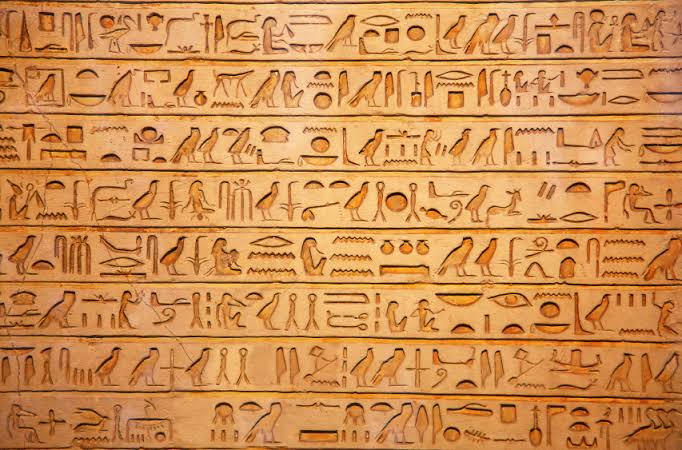
Hey timeline kin, It’s a scorching midday in 1799 near the Egyptian village of Rashid (Rosetta), and a French soldier is digging a trench to strengthen a fort when his shovel strikes something hard. He pulls out a large, dark stone slab covered with three different kinds of writing: Greek at the bottom, a strange script in the middle, and at the top, rows of beautiful, mysterious pictures — birds, eyes, snakes, and strange symbols.
The soldier doesn’t know it yet, but he has just uncovered the key that will unlock one of the greatest mysteries of the ancient world: the meaning of Egyptian hieroglyphs.This is the story of hieroglyphs — the sacred writing system of ancient Egypt that combined pictures, sounds, and ideas in a way so elegant and complex that it remained undeciphered for over 1,400 years after the civilization that created it had vanished. For more than three thousand years, these “sacred carvings” recorded the history, religion, and daily life of one of the world’s most remarkable civilizations, until a single stone and the brilliance of scholars finally brought their voices back to life.
The Birth of a Writing System (c. 3200 BC)
Hieroglyphs first appeared around 3200 BC, during the very early days of unified Egypt. The Egyptians called their writing mdw-ntr — “words of the gods” — because they believed the signs were invented by the god Thoth, the divine scribe.
Unlike modern alphabets that use letters to represent sounds, hieroglyphs were a mixed system:
- Some signs were ideograms (pictures representing ideas or objects).
- Some were phonograms (pictures representing sounds).
- Some were determinatives (signs that clarified the meaning of a word).
A single hieroglyph could function in all three ways depending on context. This flexibility made the system incredibly rich and beautiful, but also extremely difficult to learn. Hieroglyphs were primarily used for monumental and religious texts, while everyday writing relied on hieratic and later demotic scripts. Only a small elite — scribes, priests, and officials — could read and write them.
The Long Silence – 1,400 Years of Mystery (4th century AD – 1799)
After the Roman conquest and the rise of Christianity, the ancient Egyptian religion gradually died out. The last known hieroglyphic inscription was carved in 394 AD at the Temple of Philae. When the knowledge of how to read the signs was lost, the voices of ancient Egypt fell silent for over 1,400 years. Scholars could admire the beautiful carvings, but they could not understand what they said. Many believed the symbols were purely magical or symbolic, not a real writing system.
The Breakthrough – The Rosetta Stone & the Decipherment (1799–1822)
The discovery of the Rosetta Stone in 1799 changed everything. The stone contained the same text written in three scripts: ancient Egyptian hieroglyphs, demotic, and ancient Greek. Because scholars could read the Greek, it provided a crucial bilingual reference that enabled comparison.
For more than 20 years, linguists tried to decipher the hieroglyphs. The breakthrough came from a brilliant young Frenchman named Jean-François Champollion, building on earlier work by scholars such as Thomas Young. In 1822, after years of intense study, he announced that he had cracked the code. He realized that hieroglyphs were not just symbolic — they also represented sounds. By comparing the names of Ptolemaic kings and queens written in both Greek and hieroglyphs, he was able to identify phonetic signs and begin reading the ancient language again.
Decipherment of Egyptian Hieroglyphs: Historical and Intellectual Significance
The decipherment of Ancient Egyptian hieroglyphs in the early 19th century marked a major breakthrough in linguistics and Egyptology. Building on comparative analysis of the Rosetta Stone, scholars—most notably Jean-François Champollion—demonstrated that hieroglyphs functioned as a mixed system combining phonetic and symbolic elements. This discovery restored access to a written tradition that had been unreadable for over 1,400 years.
In contemporary scholarship (2026), hieroglyphic inscriptions found on temples, monuments, and funerary objects are essential primary sources for reconstructing ancient Egyptian history, religion, and administration. Rather than purely decorative symbols, these texts provide direct evidence of how one of the world’s longest-lasting civilizations recorded its beliefs, political authority, and cultural identity.
What part of the story of hieroglyphs stays with you?
The moment the French soldier dug up the Rosetta Stone?
The years of frustration before Champollion finally cracked the code?
The beauty and complexity of the signs themselves — birds, eyes, snakes, and gods?
Or the quiet miracle that after 1,400 years of silence, the ancient Egyptians can speak to us again?
The moment the French soldier dug up the Rosetta Stone?
The years of frustration before Champollion finally cracked the code?
The beauty and complexity of the signs themselves — birds, eyes, snakes, and gods?
Or the quiet miracle that after 1,400 years of silence, the ancient Egyptians can speak to us again?
Write whatever is on your mind below. I read every word.
Books that shaped how I see the history of hieroglyphs:
Books that shaped how I see the history of hieroglyphs:
- The Rosetta Stone and the Rebirth of Ancient Egypt by John Ray
- Reading the Past: Egyptian Hieroglyphs by W.V. Davies
- The Keys of Egypt by Lesley and Roy Adkins (story of Champollion)
- Egyptian Hieroglyphs for Complete Beginners by Bill Manley
Reliable sources I leaned on for key facts:
- The British Museum – The Rosetta Stone
- The Louvre – Champollion and Hieroglyphs
- Britannica – Egyptian Hieroglyphs
- Metropolitan Museum of Art – Egyptian Writing
- Champollion’s Lettre à M. Dacier (1822)


Comments