


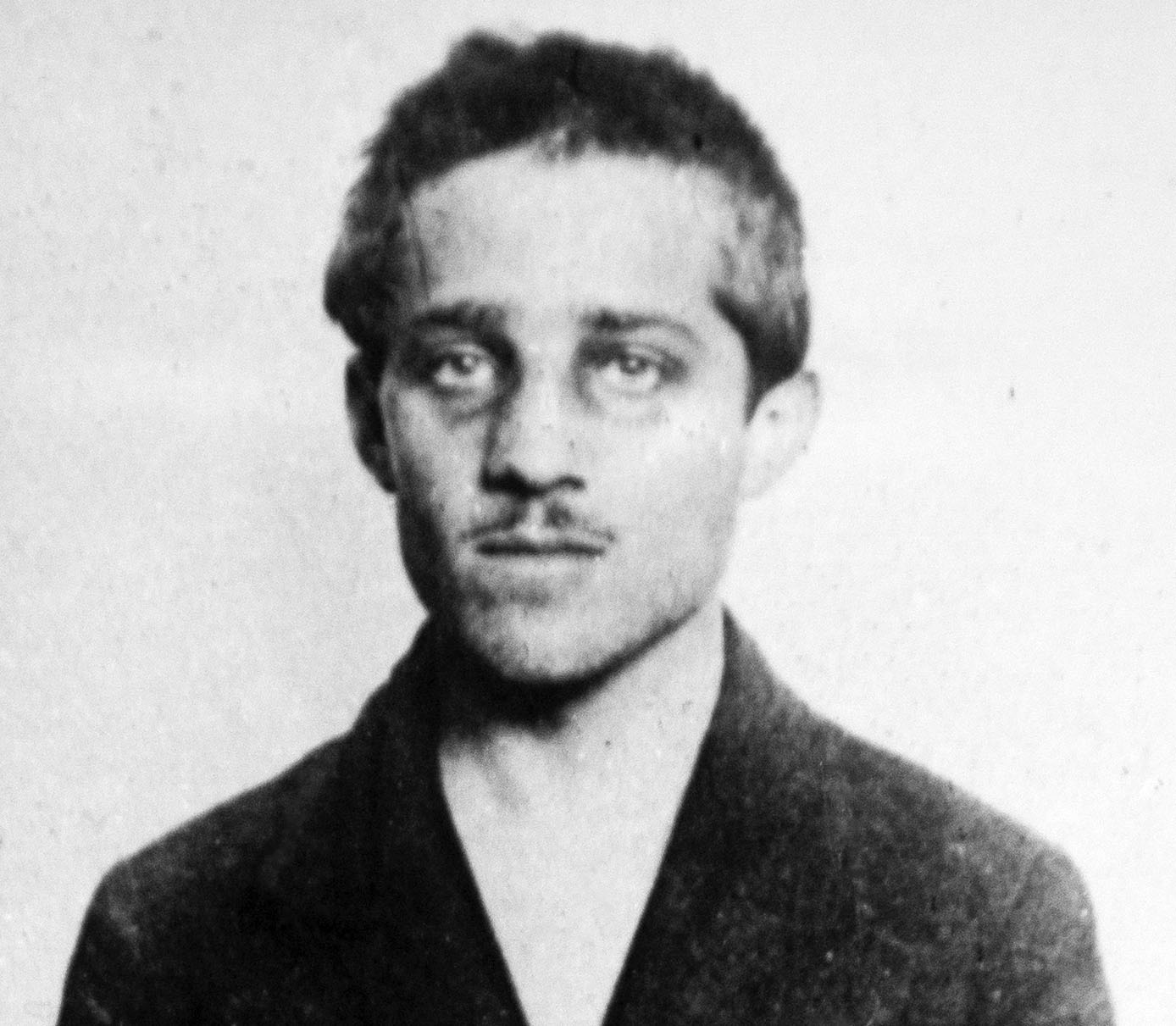
Yoo, timeline kin, imagine a narrow side street in Sarajevo on a warm Sunday morning in late June 1914. The sun is already high, the air holds the scent of dust and coffee from the nearby cafés, and a nineteen-year-old boy stands on the corner of Franz Joseph Street with a partially eaten sandwich in one hand and a Browning FN Model 1910 pistol in the other.
He has already decided he missed his chance earlier; the Archduke’s car passed minutes ago, and he was too slow, too surprised. Now he is simply waiting—nervous, hungry, angry—for the motorcade to come back somehow, even though he knows it probably won’t. Then, by pure accident, the driver of the royal Gräf & Stift makes a wrong turn and stalls the engine right in front of him. Time slows. The boy drops the sandwich, steps forward, raises the pistol, and fires twice at almost point-blank range.The first bullet hits Sophie, Duchess of Hohenberg, in the stomach. She slumps against her husband. The second hits Archduke Franz Ferdinand in the neck. He bleeds out in minutes, still murmuring her name. Within five weeks, those two shots will pull every great power in Europe into the most destructive war the world has ever seen.
The boy’s name is Gavrilo Princip. He is not a soldier, not a politician, not even a particularly experienced revolutionary. He is a Bosnian Serb teenager who believed—or had been convinced—that one act of violence could free South Slavs from Habsburg rule and unite them with Serbia. He was wrong. He helped light the fuse for a catastrophe that killed millions and redrew the map of the world.
A Boy from the Provinces (1894–1911)
Gavrilo Princip was born on July 25, 1894 (or July 13 old style), in the village of Obljaj, a remote corner of Bosnia near the border with Croatia. His family was poor, Orthodox Serb peasants. His father, Petar, was a postman who carried mail on foot across mountain paths. Gavrilo was the seventh of nine children, four of whom died in infancy. He was small, thin, tubercular from childhood, and fiercely intelligent.
At thirteen, he walked 200 miles to Sarajevo to attend school. He was bright enough to win a scholarship to the Mostar seminary, then transferred to a gymnasium in Sarajevo. There, he joined Young Bosnia (Mlada Bosna), a loose network of radical students influenced by Serbian nationalism, anarchism, and the cult of the assassin. He read Russian nihilists, Mazzini, and the poetry of the Serbian epic hero cycle. He dreamed of a united Yugoslavia free of Austria-Hungary.
In 1911, he was expelled from school for protesting against the Austro-Hungarian authorities. He moved to Belgrade, joined the secret society Unification or Death (popularly called the Black Hand), and was trained in firearms and conspiracy by Serbian army officers who wanted to destabilize Bosnia.
The Plot & the Shots at Sarajevo (1914)
In the spring of 1914, the Black Hand decided to assassinate Franz Ferdinand during his visit to Sarajevo on June 28—Vidovdan, the anniversary of the Battle of Kosovo, a date full of Serbian nationalist symbolism. Seven young Bosnians were recruited: Nedeljko Čabrinović threw the first bomb (which missed), Vaso Čubrilović and others waited along the route, and Princip was stationed as backup.
After the failed bomb attempt, the Archduke insisted on visiting the wounded in the hospital. On the return journey, the driver took a wrong turn. The car stalled directly in front of Princip. He moved forward, fired twice, then tried to turn the gun on himself but was stopped by bystanders. He was arrested immediately.
Trial, Imprisonment & Death (1914–1918)
Princip’s trial began in October 1914. He was defiant: “I am a Yugoslav nationalist. Our aim was the freedom of the Yugoslavs. I am not a criminal. I am an avenger.” Because he was nineteen (just under twenty at the time of the crime), he escaped the death penalty. He was sentenced to twenty years in prison.
He spent the war in the Theresienstadt fortress (Terezín), in harsh solitary confinement. Tuberculosis, already present before his arrest, worsened rapidly. He weighed less than 40 kg by the end. He died on April 28, 1918, aged twenty-three, of skeletal tuberculosis. The guards burned his body to prevent any grave from becoming a shrine. His bones were later moved to Sarajevo in 1920.

The Legacy of a Nineteen-Year-Old Assassin
Gavrilo Princip was not a monster. He was a young, sick, fanatical nationalist who believed one act of violence could liberate his people. He was wrong. His two bullets killed two people directly and helped unleash a war that killed seventeen million more. The empire he hated collapsed anyway, but not in the way he hoped: Yugoslavia was born in blood, fractured by ethnic hatreds, and eventually ripped itself apart again in the 1990s.
In Bosnia today, his grave in the Sarajevo cemetery is still visited by some as a hero, by others as a tragic symbol of how young lives can be sacrificed to nationalist myths. In Serbia, he is a controversial figure of national honor and shame. In the rest of the world, he is the teenage assassin whose sandwich break accidentally changed the twentieth century.
What part of Princip’s short, violent life stays with you? The boy who walked hundreds of miles to school because he wanted to learn? The radical student who joined a secret society, dreaming of freedom? The moment he moved forward, the car stalled. Or the lonely death in a Habsburg fortress, knowing the war he helped start would destroy everything he believed in? Drop whatever is on your mind below. I read every word.
Books that shaped how I see Gavrilo Princip:
- The Road to Sarajevo by Vladimir Dedijer (classic, detailed account of the assassination & Black Hand)
- The Assassination of the Archduke by Greg King & Sue Woolmans (focus on the day & the conspirators)
- Sarajevo 1914 by Christopher Clark (part of The Sleepwalkers—excellent on Princip’s background)
- The Trigger by Tim Butcher (modern journey tracing Princip’s life & legacy)
- One Morning in Sarajevo by David James Smith (narrative reconstruction of the assassination)
Reliable sources I leaned on for key facts:
- Historical Archives of Sarajevo – Princip Trial Records — court transcripts & police reports
- Museum of Sarajevo 1878–1918 — exhibits, Princip’s pistol, the car, the corner
- Yugoslav Archives – Black Hand Documents — partial records of Unification or Death
- Britannica – Gavrilo Princip — timeline & evaluation
- The Museum of the Assassination – Sarajevo — site of the assassination & modern exhibits
If you found this story of Gavrilo Princip and the spark that ignited World War I compelling, you may also like these related articles on the causes, key figures, and consequences of the Great War:
- The Assassination of Franz Ferdinand and the 37 Days That Led to World War I — A detailed look at the Sarajevo assassination and the rapid chain of events that plunged Europe into war.
- Franz Ferdinand and the Two Shots That Changed the World — The full story of the Archduke, his assassin, and how one act reshaped the 20th century.
- Wilhelm II and the Road to World War I: Ambition, Power, and Miscalculation — How Germany’s ambitious Kaiser helped turn a regional crisis into a global catastrophe.
- Wilhelm II: The Last German Kaiser and the Road to World War I — The personality and policies of the emperor who played a central role in the July Crisis.
- From Peace to Chaos: Europe After World War I — The turbulent aftermath of the war sparked by Princip’s bullets.
- Inside the Hall of Mirrors: When Germany Was Humbled at Versailles — The controversial peace treaty that tried to settle the conflict triggered in Sarajevo.


Comments