


Hey timeline kin, it’s 4:45 a.m. on September 1, 1939, and the sky over the Polish border is still the color of wet slate. Somewhere near the village of Gleiwitz, a single gunshot cracks—sharp, deliberate, almost polite in the early-morning hush.
A few seconds later, a gramophone needle drops inside a parked van, and a pre-recorded loop of Polish curses and pistol fire spills out of the radio station's loudspeakers. The sound bounces across empty fields. By sunrise, every German radio station will interrupt breakfast programs with the same furious announcement: “Polish bandits have attacked Reich territory at Gleiwitz!”At almost the same moment, the old battleship Schleswig-Holstein, anchored in Danzig harbor on a so-called “courtesy visit,” opens fire with its 280 mm guns on the Polish military depot at Westerplatte. The first shells scream across the water and explode in orange fireballs. And along a 1,400-kilometer frontier from the Baltic coast to the Carpathians, more than 1.5 million German soldiers, 2,000 tanks, 1,300 combat aircraft, and thousands of artillery pieces begin moving forward in perfect coordination.
No formal declaration of war is ever read aloud in any parliament. The invasion simply begins.
This is the first full demonstration of Blitzkrieg—the lightning war. A new way of fighting that combined fast tanks, motorized infantry, close air support, and radio-controlled coordination to achieve speed and shock on a scale the world had never seen. Within thirty-five days, Poland would cease to exist as a sovereign state. Within five years, the same method would bring most of Europe to its knees. And yet Blitzkrieg was never a formal doctrine written in a German staff manual; it was a practical evolution born from necessity, technology, and a few men who refused to think like the generals of 1914–1918.
The Seeds: Lessons from the Trenches and the Interwar Years (1918–1935)
After the armistice in 1918, the German army was limited to 100,000 men under the Treaty of Versailles—no tanks, no air force, no heavy artillery, no general staff. But the Reichswehr (later Wehrmacht) quietly kept thinking. Officers studied the failures of trench warfare and the few successes of mobile operations: German stormtrooper tactics of 1918, British tank raids at Cambrai (1917), and French use of motorized infantry.
In the 1920s, a small group of officers—Hans von Seeckt, Heinz Guderian, Oswald Lutz—began experimenting in secret:
- Guderian read British tank theorists (Fuller, Liddell Hart) and French writers (Estienne, de Gaulle).
- He watched the few tanks Germany was allowed to build in Russia (secret cooperation at the Kazan Tank School under the Treaty of Rapallo).
- He pushed the idea that tanks should not support infantry; infantry should support tanks. Speed, concentration, deep penetration, and disruption of command and supply.
By 1935, when Hitler openly repudiated Versailles and reintroduced conscription, Germany had three experimental panzer divisions. Guderian’s book Achtung – Panzer! (1937) became the bible of mobile warfare. The Luftwaffe—reborn under Göring—trained for close air support. Radio communication between tanks, planes, and headquarters became standard. The pieces were in place.
First Tests: Spain, Austria, Czechoslovakia (1936–1939)
The Spanish Civil War (1936–1939) served as Germany's live-fire laboratory. The Condor Legion—mostly Luftwaffe units—perfected dive-bombing (Stuka), close air-ground coordination, and terror bombing (Guernica). Panzer crews tested early PzKpfw I and II tanks against Soviet T-26s.
The Anschluss with Austria (March 1938) was the first real motorized operation. German motorized units moved so fast that Austrian forces barely had time to react. The occupation of the Sudetenland (October 1938) and the rest of Czechoslovakia (March 1939) was bloodless but logistically perfect—tanks and trucks covered hundreds of kilometers in days with almost no breakdown.
Each operation taught the Wehrmacht the same lesson: speed paralyzes decision-making, air power disrupts rear areas, and combined-arms coordination turns small tactical advantages into operational collapse.
The Invasion of Poland – Blitzkrieg in Full Flower (September 1 – October 6, 1939)
Germany attacked Poland with three army groups:
- Army Group North (von Bock) — from East Prussia toward the Corridor and Warsaw.
- Army Group South (von Rundstedt) — from Silesia and former Czechoslovakia toward Łódź and Kraków.
- Army Group Reserve — to exploit breakthroughs.
The plan was not to conquer every kilometer but to encircle and destroy Polish armies before they could retreat or concentrate. The Luftwaffe destroyed most of the Polish air force on day one. Panzer divisions punched through weak points, motorized infantry followed, and infantry divisions mopped up. Stukas screamed down on headquarters, rail junctions, and columns on the road.
Poland had ~1 million men, but:
- Scattered along the border.
- Only ~600 light tanks/tankettes vs. 2,000 German tanks.
- Almost no modern anti-tank guns.
- No real coordination with the air force (most planes destroyed on the ground).
Key moments:
- Westerplatte held out for seven days (heroic but hopeless).
- Poznań Army counter-attacked at the Bzura River (September 9–20)—inflicted heavy losses on the Germans but was encircled.
- Warsaw was besieged from September 8; relentless bombing and artillery. City surrendered on September 27 after losing 25,000 civilians.
- Last major resistance ended at Kock on October 6.
In 35 days, Poland was erased from the map.
The Soviet Stab – September 17, 1939
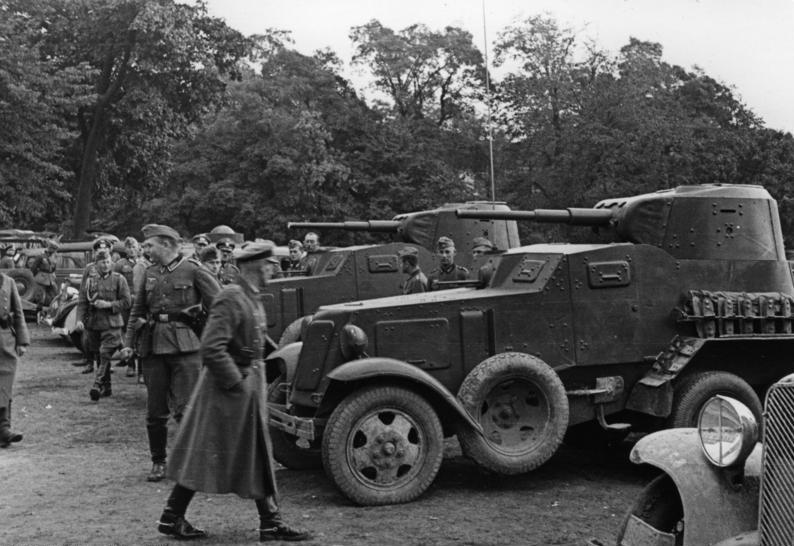
On September 17, without a declaration of war, the Red Army crossed the eastern border. Stalin claimed he was “protecting minorities.” In reality, he was collecting his share of the secret protocol of the Molotov-Ribbentrop Pact (signed August 23, 1939). Within days, the Soviets occupied Vilnius, Lwów, and everything east of the agreed line.
Germany and the Soviet Union held a joint victory parade in Brest-Litovsk on September 22. The two dictatorships divided Poland like a cake.
The West Watches – Phoney War Begins
Britain and France declared war on Germany at 11:00 a.m. and 5:00 p.m. on September 3. They did nothing else. No serious offensive in the west. The “Phoney War” or “Sitzkrieg” began. Allied troops sat in the Maginot Line while Poland burned. The guarantee to Poland proved hollow in practice. Germany could concentrate all its forces to the east without fear of a western attack.

Why September 1939 Still Matters
The invasion of Poland wasn't just the start of World War II; it was the moment when the mask finally dropped. Hitler showed he would lie, stage false-flag operations, and break every treaty. Stalin showed he would shake hands with the devil to buy time and territory. The speed of the German victory stunned the world and proved that Blitzkrieg worked. The Soviet stab in the back stunned Poland and convinced millions that the two totalitarian systems were, in practice, mirror images.
Today, when people walk the preserved ruins of Westerplatte or stand in front of the rebuilt Gleiwitz radio tower (now a museum), they remember that the Second World War did not begin with a formal declaration or a clash of millions. It began with a murdered prisoner dressed in a Polish uniform, a fake radio broadcast, and the roar of guns that did not stop for six years.
Poland was the first victim—and one of the greatest sufferers. Six million of its citizens (nearly 20% of the population) would perish before the war ended.
What part of September 1939 still unsettles you most?
The cold-blooded staging of Gleiwitz with a murdered prisoner?
The handshake between Ribbentrop and Molotov that made the double invasion possible?
The speed with which a proud nation was erased from the map in thirty-five days?
Or the terrible silence from London and Paris while Warsaw burned?
The cold-blooded staging of Gleiwitz with a murdered prisoner?
The handshake between Ribbentrop and Molotov that made the double invasion possible?
The speed with which a proud nation was erased from the map in thirty-five days?
Or the terrible silence from London and Paris while Warsaw burned?
Write whatever is on your mind below. I read every word.
Books that shaped how I understand the invasion:
- Poland 1939: The Outbreak of World War II by Roger Moorhouse (clearest narrative of the campaign)
- The Invasion of Poland 1939 by Alexander B. Rossino (detailed on German planning and false-flag operations)
- The Devils’ Alliance by Roger Moorhouse (full story of the Nazi-Soviet pact)
- Bloodlands by Timothy Snyder (human cost of the partition and early occupation)
- The War That Ended Peace by Margaret MacMillan (long background leading to September 1939)
Reliable sources I leaned on for key facts:
- Bundesarchiv – Documents on the Invasion of Poland
- Polish State Archives – September Campaign
- Wilson Center Digital Archive – Soviet-German Relations 1939
- Yad Vashem – Invasion of Poland
- Britannica – Invasion of Poland
Recommended Articles
- The Secret Pact That Allowed Hitler to Invade Poland – The backroom deal that made the invasion possible.
- The Molotov–Ribbentrop Pact: One of History’s Most Cynical Deals – The shocking Nazi-Soviet alliance that divided Poland.
- Neville Chamberlain and the Deal That Failed to Stop Hitler – The failed appeasement that ended with the invasion.
- Benito Mussolini: The Man Who Invented Fascism in Europe – The fascist model that inspired Hitler’s Blitzkrieg.
- Winston Churchill: The Reckless Politician Who Became Britain’s Wartime Hero – The leader who took over after Poland fell.


Comments