
Hey timeline kin, in the previous article, we looked at the assassination in Sarajevo and the July Crisis that plunged Europe into war. But what happened to the man who helped set those events in motion?lean against the damp sandbag parapet of a forward observation post somewhere near the Ypres Salient in the autumn of 1915. Rain has turned the trench into a knee-deep soup of mud and shattered duckboards. Through a slit in the steel plate, you can just make out the low grey sky and the distant flicker of German artillery. Somewhere in that haze, twenty miles behind the lines, sits a man who still believes he is personally commanding this war. He is fifty-six years old, wears the uniform of a field marshal he designed himself, and spends his days at Spa or Pless or some other comfortable headquarters writing telegrams full of exclamation marks, demanding offensives, counter-offensives, and “the final blow” that never quite arrives. His name is Wilhelm II, German Emperor and King of Prussia, and although the newspapers still call him Supreme War Lord, the soldiers in the mud—and the generals who now quietly ignore his orders—know the truth: he has already lost control of the machine he helped set in motion.
This is not the usual parade of dates, fronts, and casualty lists. It is the story of how Wilhelm II, a man who craved the role of military genius, ended up as a largely powerless spectator to the greatest catastrophe of his reign. His fingerprints are all over the outbreak of the war, his voice echoes in the early decisions that shaped the Western Front, and his growing irrelevance after 1916 marks one of the clearest turning points of World War I: the moment the Kaiserreich stopped being ruled by its Kaiser.
The Shadow Before the Storm – Wilhelm’s Role in the July Crisis (June–August 1914)
When Gavrilo Princip fired the shots that killed Franz Ferdinand on June 28, 1914, Wilhelm was at sea on his annual Norwegian cruise. He returned to Potsdam on July 5 and immediately gave Austria-Hungary the infamous “blank cheque”: Germany would support Vienna “whatever Austria’s chosen course” against Serbia. He did so in a handwritten note to Chancellor Bethmann Hollweg, scribbled in the margin of a telegram: “Austria must be shown that we are behind her.” Historians still argue whether Wilhelm understood how far-reaching that promise was. What is clear is that he believed—right up to the end of July—that Russia would back down, that Britain would stay neutral, and that a short, sharp war against Serbia would strengthen Austria and Germany’s position without igniting a continental fire.
He was wrong on every count. When Russia began partial mobilization on July 29, Wilhelm panicked and tried to reverse course. He sent a personal telegram to his cousin Tsar Nicholas II (“Willy” to “Nicky”) begging him to stop. He proposed that Austria occupy Belgrade and halt there. But by then, the military timetables had taken over. The Schlieffen Plan—Germany’s only war plan—demanded full mobilization and an immediate invasion of Belgium and France. Wilhelm’s last-minute attempt to halt the trains was ignored by General Moltke the Younger, who told him bluntly: “Your uncle would have given me a different answer.” The Kaiser exploded: “Your uncle would not have let me go to war at all!”
Germany declared war on Russia (August 1) and France (August 3), then invaded Belgium. Britain entered the next day. Wilhelm had helped light the fuse, then tried—too late—to blow it out.
Early War: The Kaiser as Figurehead Commander (1914–1916)
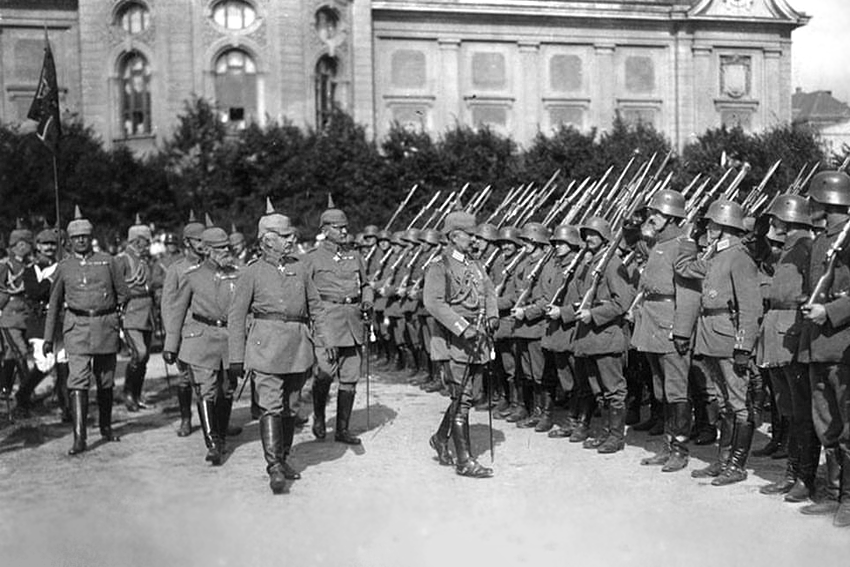
In August 1914, Wilhelm wanted to be reborn as Frederick the Great. He issued dramatic orders: “March on Paris!” He promised the troops they would be home “before the leaves fall.” He reviewed regiments in the field, posed for photographs in spiked helmets, and sent streams of telegrams to his generals full of strategic advice.
None of it mattered. The Schlieffen Plan—Germany’s only operational blueprint—had been drawn up years earlier by Count Schlieffen and modified by Moltke the Younger. Wilhelm had never seriously studied it. When the plan failed at the Marne in September 1914, and the war settled into trenches, the Kaiser was pushed to the sidelines. Real decisions were made by the Chief of the General Staff (first Moltke, then Falkenhayn, then Hindenburg & Ludendorff) and by the civilian chancellor. Wilhelm signed orders, gave speeches, and visited hospitals, but he no longer directed strategy.
His interference, when it happened, was usually harmful. He demanded offensives when the army needed time to regroup. He meddled in appointments (forcing Falkenhayn out in 1916 partly because he resented the general’s coolness toward him). He issued contradictory instructions—one day urging caution, the next demanding “the final blow.” The generals learned to ignore him politely and carry on.
The Great Verdun–Somme Disaster (1916)
The two battles that broke the German army—and Wilhelm’s illusions—came in 1916.
Verdun (February–December 1916) was Falkenhayn’s idea: “bleed France white” by attacking a place the French would defend at any cost. Wilhelm approved enthusiastically—he loved the drama of a great fortress battle. The offensive gained a few miles, cost 281,000 German casualties (French losses were similar), and achieved nothing strategic. Falkenhayn was sacked in August.
The Somme (July–November 1916) was the British answer. Fourteen British and French armies attacked along an 18-mile front. Wilhelm watched from his headquarters, issuing orders to “hold every inch.” The Germans held, but at horrific cost: 465,000–600,000 casualties. By November, the line had barely moved, yet Germany’s best troops were dead or maimed. The army never recovered its offensive spirit.
Wilhelm’s role? He visited the front, posed for photographs among the wounded, and sent telegrams praising “our brave boys.” But he no longer shaped the campaign. Hindenburg and Ludendorff took effective control in August 1916. The Kaiser became a figurehead—still Supreme War Lord in name, but a bystander in fact.
The Maritime Disaster: The British Blockade (1914–1918)
Wilhelm had dreamed of a great navy that would force Britain to respect Germany. Tirpitz’s High Seas Fleet was impressive on paper, but it never broke the Royal Navy’s grip on the North Sea. After Jutland (May 1916)—the largest naval battle of the war—the German fleet stayed in port. Britain’s blockade tightened.
The blockade starved Germany. By 1917, civilian rations were down to 1,000 calories a day. Turnips became the staple food of the “Turnip Winter” (1916–1917). Malnutrition killed hundreds of thousands. Wilhelm understood the danger but could not break the blockade. His solution—unrestricted submarine warfare (resumed January 1917)—brought the United States into the war and sealed Germany’s fate.
Losing Control: The Generals Take Over (1916–1918)
After Verdun and the Somme, Hindenburg and Ludendorff became de facto dictators. They controlled strategy, production, manpower, and even propaganda. Wilhelm signed their decrees, attended their meetings, but his suggestions were politely ignored. When Ludendorff demanded the resumption of unrestricted submarine warfare, Wilhelm agreed—against his better judgment—because he feared looking weak.
By 1918, the war was lost. The spring offensive (March–July 1918) gained ground but exhausted the last reserves. When the Allies counter-attacked in August, the German army began to crack. On September 29, Ludendorff told Wilhelm the war was militarily lost. The Kaiser, stunned, agreed to seek an armistice. On November 9, 1918, Chancellor Max von Baden announced Wilhelm’s abdication without his consent. The Kaiser fled to the Netherlands the next day.
Wilhelm II and His Role in World War I
Wilhelm II did not single-handedly cause World War I, but his decisions were critical in escalating the conflict. His unconditional support to Austria-Hungary during the July Crisis of 1914—often referred to as the “blank cheque”—encouraged aggressive action against Serbia and removed any incentive for diplomatic restraint. At the same time, his long-standing naval expansion policies intensified tensions with Britain, contributing to the broader system of rivalries that made a continental war increasingly likely.
When the crisis spiraled out of control, Wilhelm attempted a last-minute de-escalation, including personal appeals to Russia. However, by that stage, rigid military mobilization plans—especially Germany’s reliance on rapid deployment strategies—had taken precedence over political authority. This moment highlights a key structural failure: the inability of civilian leadership, including the Kaiser himself, to control the machinery of modern warfare once it had been set in motion.
As the war progressed, Wilhelm’s influence declined sharply. His early ambition to act as a hands-on military commander clashed with the realities of industrialized war, where strategic decisions were driven by professional generals and logistical constraints rather than royal authority. By 1916, real power had effectively shifted to the German High Command, leaving Wilhelm increasingly sidelined and politically irrelevant.
Today, historians continue to debate Wilhelm II’s legacy. Some interpret him as a reactive and indecisive leader overwhelmed by systemic pressures, while others view him as a key architect of Germany’s aggressive foreign policy and strategic miscalculations. What remains clear is that his reign marked a decisive transition—from the carefully managed diplomacy of the late 19th century to the catastrophic total war that reshaped Europe and the global order.
What part of Wilhelm’s role in the war stays with you? The blank cheque in July 1914? The way he lost control to Hindenburg and Ludendorff? The final humiliation of abdication? Or the simple fact that a man who wanted so badly to be a warlord ended up watching his country bleed to death from the sidelines? Drop whatever is on your mind below.
I read every word. Books that shaped how I see Wilhelm II in the war:
- The Sleepwalkers by Christopher Clark (brilliant on the July Crisis and Wilhelm’s role)
- Wilhelm II: Into the Abyss of War and Exile by John C.G. Röhl (devastating detail on the war years)
- The War That Ended Peace by Margaret MacMillan (long-term causes and Wilhelm’s missteps)
- Ring of Steel by Alexander Watson (the Eastern Front and Germany’s strategic dilemmas)
- Germany’s Western Front: Translations from the Kriegsarchiv (contemporary German documents showing how little Wilhelm influenced operations)
Reliable sources I leaned on for key facts:
If you found this tragic story of Wilhelm II’s fall from power compelling, you may also like these related articles on the end of imperial Germany and the birth of a troubled new era:
- The Fall of the German Empire: Wilhelm II, Revolution, and the Birth of Weimar (1918) — The dramatic collapse of the German Empire, Wilhelm’s abdication, and the chaotic birth of the Weimar Republic.
- Wilhelm II and the Road to World War I: Ambition, Power, and Miscalculation — How Wilhelm’s personality, ambition, and diplomatic failures helped push Europe into the catastrophic war that destroyed his empire.
- From Peace to Chaos: Europe After World War I — The turbulent post-war years filled with revolution, economic despair, and political instability.
- Inside the Hall of Mirrors: When Germany Was Humbled at Versailles — The humiliating Treaty of Versailles that sealed Germany’s defeat and deepened the resentment that followed Wilhelm’s reign.
- The Beer Hall Putsch and the Unexpected Rise of Adolf Hitler — How the chaos and humiliation left behind after Wilhelm’s empire collapsed created fertile ground for extremism.
- Paul von Hindenburg and the Fate of the Weimar Republic — The aging field marshal who later played a key role in the final years of Weimar democracy.




Comments