


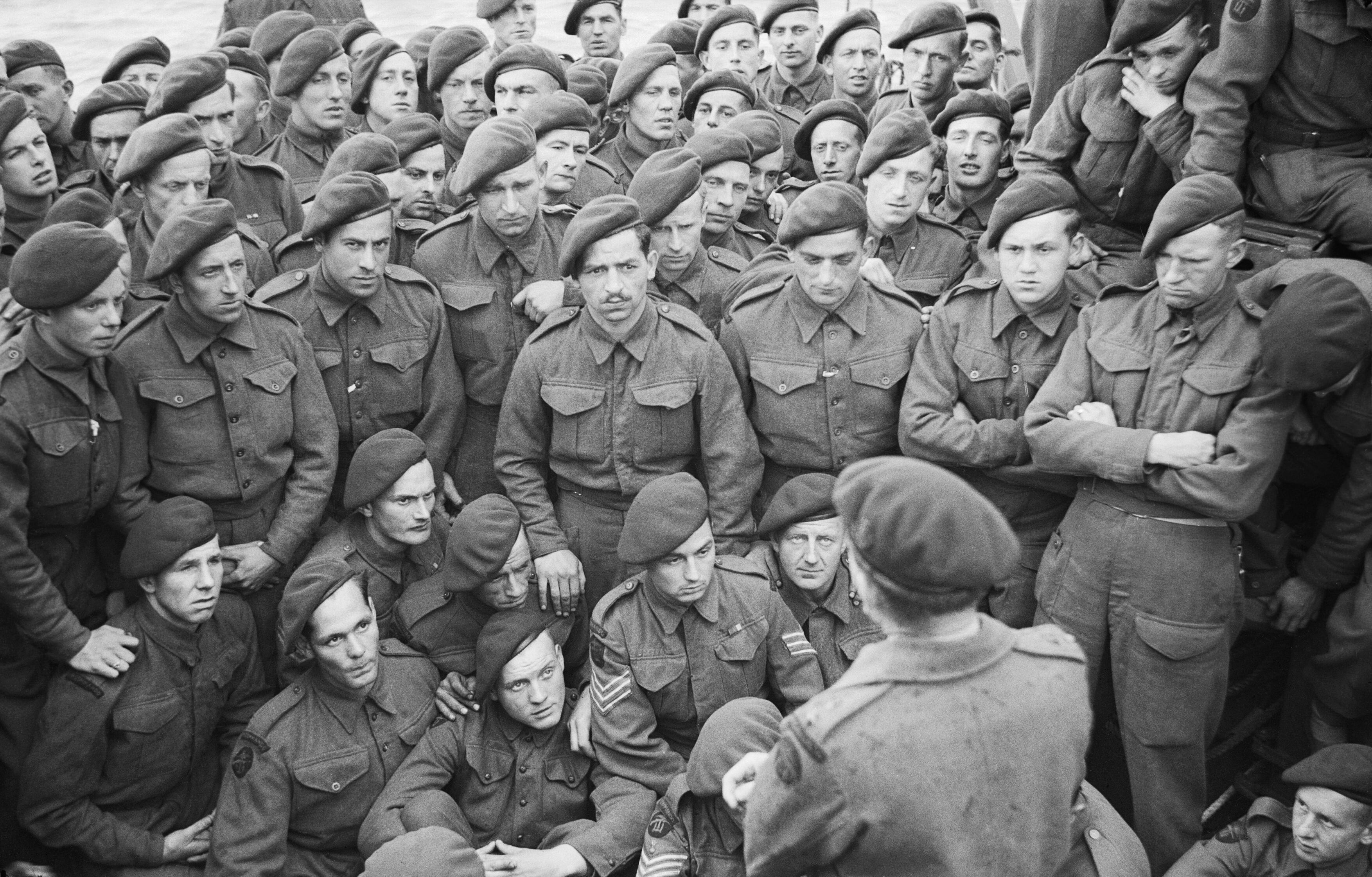
Hey timeline kin, it’s 5:15 a.m. on June 6, 1944, and you’re seated in the belly of an LCVP landing craft somewhere off the Normandy coast. The steel ramp in front of you is still clamped shut. The boat is rolling hard in the chop; seawater sprays over the gunwales and soaks your wool battledress.
Forty-eight other men are packed in with you—rifles between knees, cigarettes cupped against the wind, faces wan under black camouflage paint. Someone is vomiting into his helmet. Another is praying under his breath in Brooklynese. The coxswain yells over the engine roar: “Five minutes!” You can already listen to the distant thump-thump-thump of German 88s firing from the cliffs ahead. Somewhere above, thousands of C-47s have just dropped paratroopers into the dark fields of the Cotentin Peninsula. Out to sea, the biggest armada ever assembled—nearly 7,000 vessels—is waiting to vomit men and machines onto five beaches code-named Utah, Omaha, Gold, Juno, and Sword.In the next eighteen hours, more than 156,000 Allied troops will come ashore, 4,414 will be killed, and the largest amphibious invasion in history will either succeed in opening a second front in Europe—or fail and give Nazi Germany another year or two to perfect its secret weapons and consolidate its conquests. This is D-Day, the Normandy landings: not a single clean stroke, but a disorderly, bloody, improvised miracle of planning, courage, and sheer industrial weight that cracked the Atlantic Wall and began the liberation of Western Europe.
Planning the D-Day Invasion: Operation Overlord (1940–1944)
After Dunkirk (June 1940), Britain stood alone. Churchill vowed to return to the continent, but no one knew when or how. The United States entered the war after Pearl Harbor (December 1941). However, American troops were green, the British army still recovering, and the Allies had to build everything from scratch: landing craft, artificial harbors (Mulberry), specialized tanks (Hobart’s Funnies), and a deception plan so elaborate it convinced Hitler the main blow would come at Calais, not Normandy.
Planning for Overlord began in 1943 under Lieutenant-General Frederick Morgan. General Dwight D. Eisenhower became Supreme Commander in December 1943. The target was Normandy—less heavily defended than the Pas-de-Calais, within fighter range of England, and with good beaches for follow-up waves.
Key elements:
- Air supremacy: Allied air forces flew 14,000 sorties on D-Day alone, destroying bridges, railways, and Luftwaffe bases.
- Naval bombardment: Seven battleships, twenty-three cruisers, and dozens of destroyers pounded the beaches.
- Airborne drops: Two American (82nd & 101st) and one British (6th) airborne division dropped behind the beaches to seize bridges and causeways.
- Deception: Operation Fortitude kept German reserves (15th Army) pinned at Calais with fake armies, dummy tanks, and bogus radio traffic.
D-Day Beaches: Utah, Omaha, Gold, Juno, and Sword (June 6, 1944)
Utah (U.S. 4th Infantry Division)
Easiest landing. Strong tides pushed the boats 2,000 yards south of target—into a lightly defended sector. Casualties: ~200. Beach secured by noon.
Easiest landing. Strong tides pushed the boats 2,000 yards south of target—into a lightly defended sector. Casualties: ~200. Beach secured by noon.
Omaha (U.S. 1st & 29th Infantry Divisions)
The bloodiest. High cliffs, strong German defenses (352nd Infantry Division), and poor naval bombardment accuracy. The first wave was almost wiped out. Men drowned under 60-pound packs; others were cut down on the shingle. By nightfall, the beachhead was only 1,000 yards deep. Casualties: ~2,400.
The bloodiest. High cliffs, strong German defenses (352nd Infantry Division), and poor naval bombardment accuracy. The first wave was almost wiped out. Men drowned under 60-pound packs; others were cut down on the shingle. By nightfall, the beachhead was only 1,000 yards deep. Casualties: ~2,400.
Gold (British 50th Division)
Heavy fighting at Arromanches (future Mulberry harbor site). Beachhead linked with Juno by evening. Casualties: ~1,000.
Heavy fighting at Arromanches (future Mulberry harbor site). Beachhead linked with Juno by evening. Casualties: ~1,000.
Juno (Canadian 3rd Division)
Fastest inland penetration. Canadians pushed 6–7 miles by nightfall despite heavy losses on the beach. Casualties: ~1,000.
Fastest inland penetration. Canadians pushed 6–7 miles by nightfall despite heavy losses on the beach. Casualties: ~1,000.
Sword (British 3rd Division)
Reached 5 miles inland but failed to take Caen (D-Day objective). Casualties: ~700.
Reached 5 miles inland but failed to take Caen (D-Day objective). Casualties: ~700.
Airborne drops were scattered—paratroopers landed miles off target—but they disrupted German communications and seized key bridges (Pegasus, Horsa).
After D-Day: The Normandy Breakout and Liberation of France (June–August 1944)
By June 12, the five beaches were linked into a single lodgement 60 miles wide. Caen fell on July 19 after brutal urban fighting. Operation Cobra (July 25) broke out of Normandy; Patton’s Third Army raced south and east. Paris was liberated on August 25. By August 30, the Allies reached the Seine. The Battle of Normandy cost:
- Allies: ~209,000 casualties (37,000 dead).
- Germans: ~400,000–450,000 (200,000+ killed or captured).
The Atlantic Wall was breached. The road to Germany was open.

The Meaning of D-Day: Why the Normandy Invasion Changed World War II
The Normandy landings—widely known as D-Day—marked a decisive turning point in World War II, opening a long-awaited Western Front against Nazi Germany. More than 156,000 Allied troops landed on the beaches of Normandy on June 6, 1944, in the largest amphibious invasion in history, supported by vast naval, air, and logistical operations under Dwight D. Eisenhower.
D-Day was not won on the beaches alone. Its success depended on years of preparation and coordination across continents—from strategic planning in London and Washington, to industrial production in Allied factories, to deception operations like Operation Fortitude, which kept German armored divisions away from Normandy. Air superiority, naval bombardment, and airborne operations all played decisive roles in securing the beachheads and enabling the advance into occupied France.
The impact of D-Day was immediate and far-reaching. Within weeks, Allied forces broke out of Normandy, liberated Paris in August 1944, and began the final push toward Germany. The invasion accelerated the collapse of Nazi control in Western Europe and contributed directly to the eventual defeat of Adolf Hitler and the end of the war in Europe in May 1945.
Today, the legacy of D-Day is preserved at sites across Normandy. Visitors walking along Omaha Beach or standing at the Normandy American Cemetery—where 9,388 white crosses stretch toward the sea—encounter a landscape shaped by memory and sacrifice. These places serve as enduring reminders of June 6, 1944: the day the Allies returned to Western Europe and began the final chapter of Nazi Germany’s defeat.
What part of D-Day stays with you?
The spooky silence before the first landing craft ramps dropped?
The chaos in Omaha, where the first wave was almost annihilated?
The paratroopers who jumped into darkness and still held their objectives?
Or the simple, staggering fact that 156,000 men came ashore on five beaches in one day—and changed the course of the war?
The spooky silence before the first landing craft ramps dropped?
The chaos in Omaha, where the first wave was almost annihilated?
The paratroopers who jumped into darkness and still held their objectives?
Or the simple, staggering fact that 156,000 men came ashore on five beaches in one day—and changed the course of the war?
Write whatever is on your mind below. I read every word.
Books that influenced how I see D-Day:
- D-Day: The Battle for Normandy by Antony Beevor (the modern standard—vivid, balanced)
- D-Day, June 6, 1944, by Stephen E. Ambrose (classic narrative, oral histories)
- The Bedford Boys by Alex Kershaw (focus on one company from Bedford, Virginia)
- Overlord by Max Hastings (strategic overview & soldier experience)
- D-Day Through German Eyes by Holger Eckhertz (rare German accounts)
Reliable sources I leaned on for key facts:
- The National WWII Museum – D-Day
- Imperial War Museums – D-Day
- U.S. Army Center of Military History – Normandy
- Britannica – Normandy Invasion
- Normandy Tourism – Official D-Day Sites
Recommended Articles
- Winston Churchill: The Reckless Politician Who Became Britain’s Wartime Hero – The leader who championed the D-Day invasion.
- Franklin D. Roosevelt: The President Who Changed America Forever – The U.S. president who made D-Day possible.
- Operation Barbarossa: When the Nazi War Machine Met Its Match – The Eastern Front disaster that set the stage for D-Day.
- The Battle of Britain: When Hitler Failed to Conquer the Skies – The stand that kept Britain alive until D-Day.
- Stalingrad: The 199-Day Battle That Broke Hitler’s Army – The turning point on the Eastern Front that weakened Germany before Normandy.


Comments