


Hey timeline kin, A warm spring morning in 1932 unfolded in the crowded streets of Shanghai’s Hongkew Park as dignitaries gathered for a ceremony honoring Emperor Hirohito’s birthday. Suddenly, a thunderous explosion ripped through the crowd. Shrapnel tore into the Japanese delegation. One man, the Japanese minister to China, crumpled to the ground, his right leg shattered beyond repair.
Doctors later amputated it below the knee. That injured diplomat, leaning on a cane for the rest of his life, was Mamoru Shigemitsu. Years later, the world would watch him limp awkwardly across the deck of the USS Missouri to sign the document that ended World War II.This is the story of a career diplomat who navigated the treacherous waters of pre-war Asia, served as foreign minister during Japan’s darkest hours, and became the civilian face of surrender in 1945. A moderate voice often drowned out by militarists, he survived assassination attempts, war crimes trials, and prison, only to return to politics and help rebuild his defeated nation. His life embodies the painful contradictions of Japan’s 20th-century journey — from imperial ambition to postwar reconciliation.
Mamoru Shigemitsu Early Life and Diplomatic Career (1887–1931)
Born on 29 July 1887 in what is now Bungo-ōno, Ōita Prefecture, on the southern island of Kyushu, Shigemitsu came from modest roots. He graduated from the Law School of Tokyo Imperial University in 1911 and promptly joined the Ministry of Foreign Affairs. His early postings took him across Europe: Poland, Germany, and attendance at the Paris Peace Conference after World War I.
By the late 1920s, he had risen steadily. He served as consul general in Shanghai and, in 1931, became Japan’s minister to China. Fluent in several languages and known for his calm demeanor, Shigemitsu believed in careful diplomacy rather than military confrontation. Yet the rising tide of Japanese militarism and Chinese nationalism made his work increasingly dangerous.
Shanghai Bombing 1932: Shigemitsu’s Leg Amputation and Survival
The 1932 Shanghai bombing left Shigemitsu with a wooden prosthetic leg and a permanent limp. The attack, carried out by a Korean independence activist named Yun Bong-gil, also killed a Japanese general. Despite the pain and disability, Shigemitsu continued his career without bitterness. He rose to vice-minister of foreign affairs in 1933, then served as ambassador to the Soviet Union (1936–1938) and to Great Britain (1938–1941). In London, he watched with growing concern as Japan drifted toward war with the Western powers.
Mamoru Shigemitsu as Japan’s Foreign Minister During WWII
As the Pacific War turned against Japan, Shigemitsu was recalled to Tokyo. In April 1943, he became foreign minister in Hideki Tojo’s cabinet, later continuing under Kuniaki Koiso. He also briefly held the post of Minister of Greater East Asia. Though part of wartime governments, Shigemitsu was known as a moderate who quietly favored conciliatory policies and hoped for an earlier negotiated peace. He opposed the most extreme militarist factions and advocated better treatment of prisoners of war, though his influence was limited.
By the summer of 1945, with Japan facing total defeat, Shigemitsu served briefly in Prince Higashikuni’s cabinet. When the decision came to accept the Potsdam Declaration, many senior figures shrank from the responsibility. Shigemitsu stepped forward.
Japanese Surrender on USS Missouri: Shigemitsu Signs for Japan
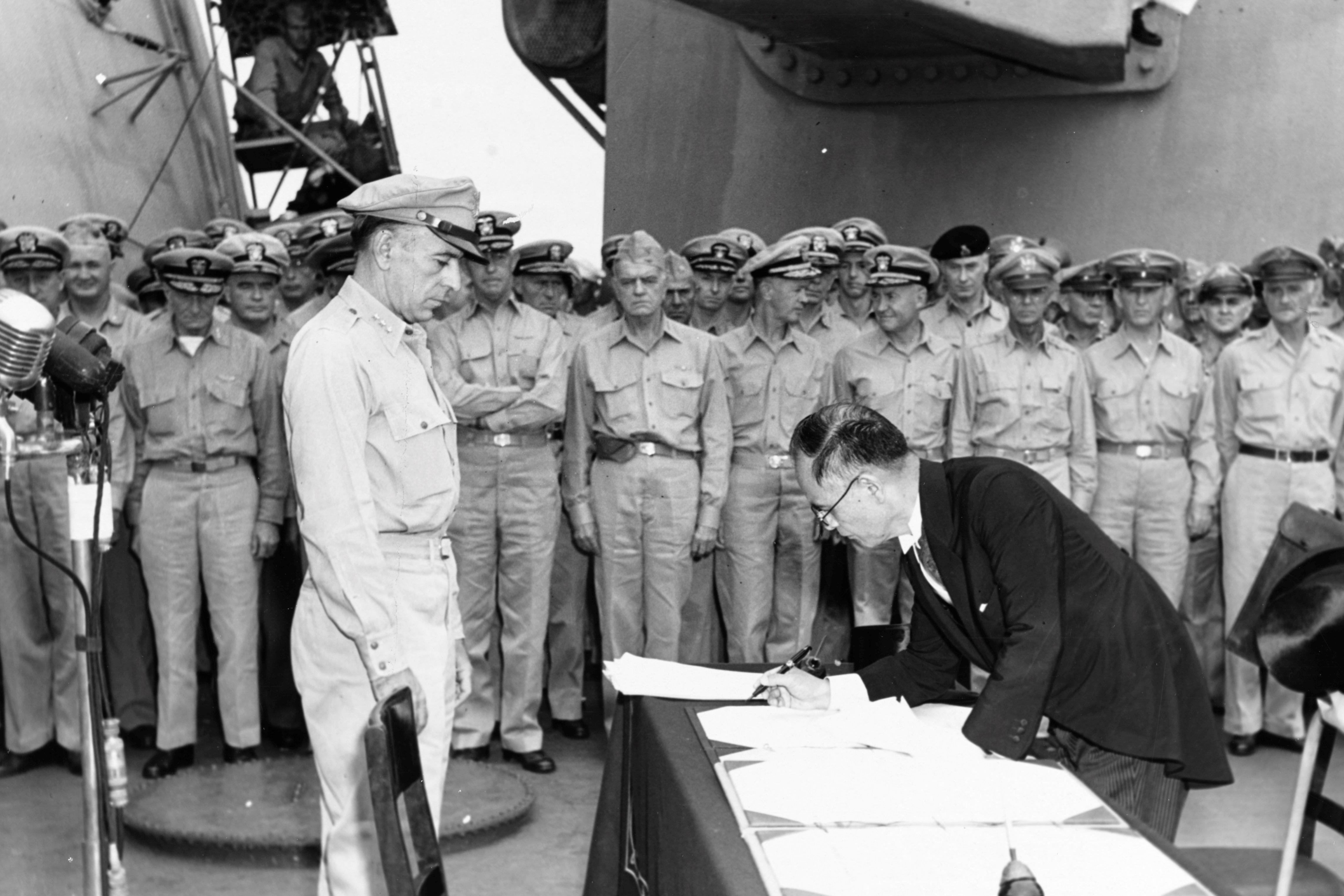
On a humid morning in Tokyo Bay, the Japanese delegation boarded the battleship USS Missouri. Dressed in a formal morning coat and top hat, Shigemitsu limped slowly to the signing table, supported by his cane. At 9:04 a.m., he signed the Japanese Instrument of Surrender on behalf of the Emperor and the government. General Yoshijiro Umezu signed for the military. The war was officially over.
Shigemitsu later described the moment as one of profound national humiliation, yet he accepted the duty when others would not.
Shigemitsu’s Tokyo Trial, Imprisonment, and Postwar Return
After the surrender, Shigemitsu was arrested and tried at the International Military Tribunal for the Far East (Tokyo Trial). Despite testimony that he had opposed aggressive war and protested mistreatment of POWs, he was convicted on one count related to responsibility for prisoner welfare. He received a seven-year sentence — the lightest among Class A defendants. Many, including some Allied figures, believed he should not have been tried at all.
He served time in Sugamo Prison and was paroled in 1950. Released from the purge in 1952, Shigemitsu re-entered politics. He helped form the Japan Democratic Party, served as its vice president, and in 1954–1956 returned as foreign minister under Prime Minister Ichiro Hatoyama. In that role, he worked to normalize relations with the Soviet Union, secure Japan’s admission to the United Nations, and strengthen ties with the United States.
On 26 January 1957, at age 69, Mamoru Shigemitsu died of a heart ailment at his home in Yugawara, Kanagawa Prefecture.
Mamoru Shigemitsu: A Life of Duty, Diplomacy, and Postwar Reconstruction
Shigemitsu Mamoru was neither an extreme militarist nor a passive bystander during Japan’s turbulent 20th century. As a career diplomat and Japan’s wartime foreign minister, he navigated the nation through crises, from prewar tensions in Shanghai to the devastation of World War II. By signing the Japanese Instrument of Surrender aboard the USS Missouri on 2 September 1945, he symbolically ended Japan’s imperial ambitions and helped pave the way for the country’s postwar reconstruction and reintegration into the international community.
His wooden leg, a permanent reminder of the 1932 Shanghai bombing, became a subtle emblem of personal sacrifice and resilience. Shigemitsu’s calm, measured approach to diplomacy contrasted sharply with the hardline militarists around him, demonstrating how moderate voices could still influence history in moments of national crisis.
Even today, Shigemitsu’s career is studied in Japanese diplomatic history, World War II studies, and postwar international relations, highlighting the importance of leadership, negotiation, and moral courage in shaping the course of nations. His life serves as a case study in how diplomats can uphold principles, survive conflict, and contribute to rebuilding a nation after total defeat.
What lingers with you about this resilient diplomat?
The young foreign service officer attending the Paris Peace Conference after World War I?
The explosion in Shanghai that cost him his leg yet failed to break his spirit?
The solemn limp across the deck of the USS Missouri on 2 September 1945?
Or his quiet postwar comeback, serving again as foreign minister and helping Japan rejoin the world?
The young foreign service officer attending the Paris Peace Conference after World War I?
The explosion in Shanghai that cost him his leg yet failed to break his spirit?
The solemn limp across the deck of the USS Missouri on 2 September 1945?
Or his quiet postwar comeback, serving again as foreign minister and helping Japan rejoin the world?
Write whatever is on your mind below. I read every word.
Books that shaped how I see Mamoru Shigemitsu:
Books that shaped how I see Mamoru Shigemitsu:
- Japan’s Quest for Autonomy: National Security and Foreign Policy 1930–1938 by James B. Crowley
- The Tokyo War Crimes Trial by Richard Minear
- Biographies and diplomatic memoirs from the Showa era
Reliable sources I leaned on for key facts:
- Britannica – Shigemitsu Mamoru
- Wikipedia – Mamoru Shigemitsu
- Naval History and Heritage Command – Japanese Surrender Ceremony
- U.S. National Archives – Japanese Surrender Document
- International Military Tribunal for the Far East Records
- Ministry of Foreign Affairs of Japan – Historical Diplomatic Archives
- Pacific War Museum – Surrender on the Missouri
Some men sign treaties in glory. Shigemitsu signed one in defeat — then spent the rest of his life trying to rebuild what was lost.
Related Articles
- Yoshijiro Umezu: The Japanese General Who Signed WWII Surrender on USS Missouri
- The Day the Guns Fell Silent: Japan’s Final WWII Surrender
- The Rise and Fall of Japan’s Greater East Asia Co-Prosperity Sphere
- Asia for Asians? The Dark Truth of Japanese Rule in World War II
- The Man Who Allied Japan with Hitler
- When Ordinary People Fought Back Against Japan’s Occupation


Comments